
How to Turn Your Vision into a Plan Your Team Can Actually Execute


John Nieuwenburg
John Nieuwenburg has been a professional business coach since 2004. Prior to becoming a coach, he held executive positions with Tip Top Tailors and BC Liquor Stores. In 2019, MacKay CEO Forums awarded him with Canada’s CEO Trusted Advisor Award in the Small Business category. Since becoming a coach, John has worked with over 400 clients, taking them through a systematic process that helps them feel organized, confident and in control of their businesses.
Your Team Can’t Execute a Plan That’s Still in Your Head
As former president Eisenhower famously said, “Plans are useless, but planning is indispensable.”
Or as Mike Tyson put it, “Everybody has a plan until they get punched in the mouth.”
Both of these quotes point to the same truth, and it’s one that every business owner needs to understand: the plan itself isn’t the thing.
The planning (and the structure you build around it) is what actually moves the needle.
I’ve worked with over 400 business owners, and here’s what I see all the time.
The vision is there. The ambition is there. They know roughly where they want to go. But the plan is still bouncing around inside their head. It hasn’t been crystallized, broken down, or communicated to the people who need to help execute it.
And that’s the gap.
Not a lack of ideas. A lack of structure.
You Create Everything Three Times
This is something I picked up from Stephen Covey, and I come back to it constantly with my clients.
When humans create, we do it three times.
First, we create in our imagination: we picture the future we want.
Second, we create a representation of it: like a blueprint or a map. That’s the plan.
Third, we manifest it: we go out and make it happen in the real world.
Most business owners are stuck somewhere between step one and step two. They’ve got the vision, and maybe even some notes on paper, but they haven’t turned it into something their team can actually execute.
No architect would show up at a job site with a truckload of bricks and say, “Let’s just start laying them down.”
Yet I see business owners all the time who want to grow their revenue by 30 percent but haven’t actually produced a plan that tells anyone (including themselves) what needs to happen next.
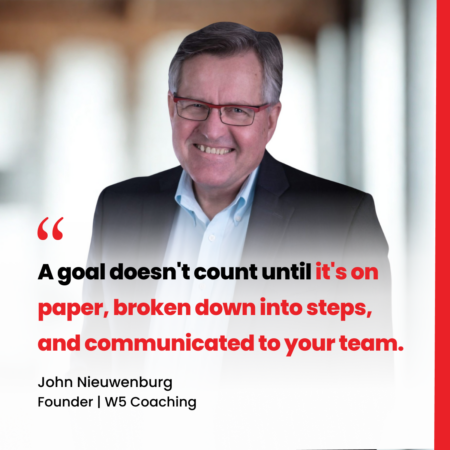
A goal doesn’t count until it’s on paper, broken down into steps, and communicated to your team.
The Anatomy of a Great Action Plan
So what does a solid action plan actually look like? There are a handful of components that separate a real plan from a wish list.
First, you need measurable goals. Not “grow the business.” Something specific enough that you’ll know whether you hit it or not.
From those goals, you identify activities: the things that need to happen to get you there.
Those activities usually look like projects, and projects are big, multi-step undertakings that need to be broken into their component parts. This is where many owners get stuck. They see the project “overhaul our onboarding process” or “launch a new service line” — but they don’t break it down into the individual, actionable steps that someone on their team can actually pick up and run with.
Each of those steps needs a deadline, an owner, and some form of accountability. Along with an agreed-upon finish line so that everyone knows what “done” looks like and when it’s expected.
And finally, you need a dashboard. This is some mechanism that allows you to review progress in your daily, weekly, and monthly team meetings so that everybody knows what’s on track and what isn’t.
Green Light, Yellow Light, Red Light
I like to think of the dashboard in terms of a traffic light system. At any given time, your business might have 90 or 100 things in motion.
Maybe 80 of them have a green light. They’re working well, on track, and need no special attention. That’s great. Leave them alone.
Maybe 10 of them have a yellow light. These are the things that need some further guidance, some instruction, some kind of help. They’re not in crisis, but they need a nudge.
And then maybe two of them are red. Those are the urgent ones. Something needs to change immediately.
The power of this kind of dashboard isn’t just that it tells you where the problems are. It’s that it gives your entire team a shared picture of reality.
When you walk into your weekly meeting and everyone can see the same green, yellow, and red signals, the conversation becomes focused and productive.
You’re not guessing. You’re not relying on someone to “bring up” a problem. The system surfaces it for you.
That’s what it means to lead through a plan instead of just having one.
Commit to the Outcome, Not the Plan
Here’s the mindset piece that ties it all together: the people who achieve their goals don’t do it because they had a perfect plan. They do it because they committed fully to the outcome.
The plan will change. It has to. The process will evolve as circumstances shift (and they always shift!) It can be tempting to hang on to an original plan, even one that’s clearly not working, if you aren’t sure what to do next.
But if you’ve committed to the outcome — really committed, not “it would be nice” committed — then you adapt. You adjust the plan, but you don’t adjust the destination.
I encourage my clients to adopt this mindset: the only thing left to negotiate is how much effort reaching the goal will take. The fact that you’re getting there is not up for discussion.
That kind of commitment, combined with the structure of a real action plan and the visibility of a dashboard your whole team can see, is what turns a vision into results.
From Planning to Leading
If you’re running a business with a team, planning isn’t just a personal exercise anymore. It’s a leadership function.
Your job isn’t to do all the work. It’s to make sure everyone on your team knows where you’re going, what their part in getting there looks like, and how you’ll all know whether things are on track.
The good news is that this doesn’t have to be complicated. Measurable goals, activities broken down into actionable steps, deadlines, accountability, and a simple dashboard you review together regularly. That’s the framework.
Success comes from actually doing it. Consistently, week after week, month after month.
And if you’d like some help building that structure, I’m here for it.
Book a free 15-minute call to talk about how coaching can help you turn your plans into something your team can execute.
Build a Self-Managing Company
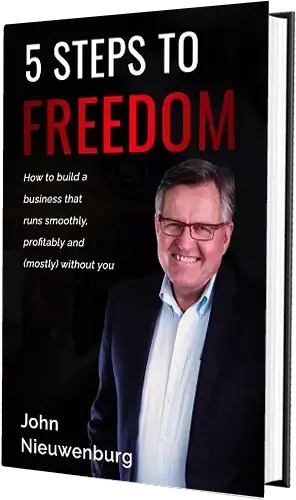
How to build a business that runs smoothly, profitably, and (mostly) without you.
Feeling stressed out and overwhelmed with a business that is taking all your time - and not giving you enough in return?
Are you finding it challenging to hire the right team (and get them to do the right things)?
I wrote this little guide for you!
Enter your details below to receive your free copy!