
Using your Intuition to Make Better Business Decisions

John Nieuwenburg
John Nieuwenburg has been a professional business coach since 2004. Prior to becoming a coach, he held executive positions with Tip Top Tailors and BC Liquor Stores. In 2019, MacKay CEO Forums awarded him with Canada’s CEO Trusted Advisor Award in the Small Business category. Since becoming a coach, John has worked with over 400 clients, taking them through a systematic process that helps them feel organized, confident and in control of their businesses.
When your gut tells you what you don’t want to hear, listen to it.
Most of the mistakes I’ve made in life came from not paying attention to my intuition early enough.
Something felt wrong. And I lived with it. I swallowed my tongue.
Usually, I ignored it because the truth was inconvenient.
Every owner I’ve ever coached has had a moment like this:
You’ve got a team member who’s “fine.” But something about them feels off.
Or you’re about to take on a project that looks great on paper. Yet there’s a quiet tug in your stomach that says, “Don’t do it.”
You already know what’s right.
You just don’t like what it means.
Firing someone, walking away from revenue, or admitting that a partnership isn’t working are uncomfortable decisions.
It’s easier to tell yourself, “Let’s get more data,” or “Maybe it’ll sort itself out.”
But deep down, you know.
Your intuition is your experience recognizing a pattern.
 People talk about intuition as if it’s magic.
It’s not. It’s experience.
Cognitive science calls it subconscious Bayesian reasoning.
In plain English, your brain is constantly updating its internal database. It notices patterns and compares them to what’s happened before.
After years of running a business, you’ve built up a massive database of patterns:
- clients who turned out to be trouble,
- employees who never quite fit,
- deals that started shiny and ended messy.
When something new feels familiar, your subconscious lights up before your logical mind can catch up.
That’s your intuition.
Think of it as fast logic. It’s been trained by repetition and hard-won lessons.
Why do so many owners ignore their intuition?
The short answer? Fear.
When your gut speaks, it doesn’t usually whisper, “Relax, you’re fine.”
It says, “Something needs to change.”
That’s uncomfortable.
Acting on intuition often means doing hard things.
It might mean having a difficult conversation, letting someone go, walking away from an opportunity, or facing a truth you’ve been avoiding.
So you do what smart people often do: you overthink.
You analyze, gather data, call more meetings, and look for more information.
Anything to delay the emotional work of doing what you already know is right.
When you override intuition, you buy short-term comfort at a long-term cost.
I’ve seen owners hold on to the wrong employee for six extra months because “they’re not that bad.”
Or double down on a losing project because “we’ve already invested so much.”
Every time, their intuition was right early. But action came late.
The problem never went away while they waited.
It only had one direction to go, and that was getting worse.
Acting on your intuition is part of becoming a leader owner.
The hardest part of leadership isn’t knowing what to do. It’s having the courage to do it.
That’s a big part of the shift from operator owner to leader owner.
A leader owner doesn’t wait for a problem to get bad enough to force their hand. They make the hard call while it’s still a small one.
Making those calls early starts with how you treat your intuition.
I have two rules I now live by, and I advocate them for every business owner I work with.
First, pay attention to your intuition. If your stomach hurts every time you think about a given situation, that’s a clue. In my experience, your intuition is right 90 to 95% of the time.
Second, act on it. That’s what puts you back in control. You’re the person with options again.
So the next time your stomach tightens up over a decision, ask yourself:
“What truth am I avoiding?”
The first answer that comes to mind is usually the thing you’ve been putting off. The sooner you act on it, the smaller the problem you’ll have to deal with.
If you’ve got one of those on your plate right now, let’s talk it through. You probably already know the answer. On a short call, I’ll ask the questions that help you say it out loud and figure out your first step. Book a free 15-minute call with me.
Our proven business coaching program has delivered results to over 400 clients
Business coaching can help you:
- Improve operations, implement systems and remove bottlenecks so that you get your time back
- Hire and train the right team and eliminate people problems
- Grow your business with bigger and better clients
- Overcome cash flow issues and improve your financial management
- Make better decisions and become more profitable
When your business runs well, you get your life back.
Services are confidential.
Click here for full details or click the red button to schedule a complimentary 15-minute call.

Coaching only works when there's a good fit between coach and client. If you'd like to explore coaching, book a confidential 15-minute call so we can get to know each other.
More on making hard decisions, overthinking, and becoming a leader owner
How to Make Good Business Decisions
Three strategies I used as a CEO to make decisions, including why I trust my own intuition when I’m diagnosing a client’s problem.
What do you do when you’re stuck trying to decide between 2 bad options?
How to get unstuck when both choices look bad, starting with the hats, haircuts and tattoos test for how permanent a decision really is.
4 Strategies to Overcome Overthinking
Eight signs you’re overthinking a decision, and four ways to stop the fear and doubt behind it from keeping you stuck.
The Leadership Skill Most Business Owners are Avoiding
Why owners put off difficult conversations with employees, suppliers and customers, and how to have them before the problem gets worse.
The Truth About Comfort Zones
My skiing story about what happens when you stop pushing past what’s comfortable, plus the four zones between comfort and danger.
Stuck in the Middle of Everything? It’s Time to Become a Leader Owner.
A video on the five stages of the Owner Evolution, and why the move from operator owner to leader owner is the hardest one to make.
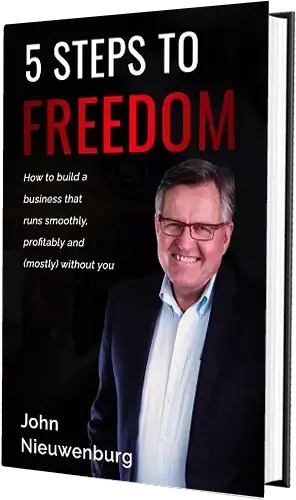
Build a Self-Managing Company
How to build a business that runs smoothly, profitably, and (mostly) without you.
Feeling stressed out and overwhelmed with a business that is taking all your time - and not giving you enough in return?
Are you finding it challenging to hire the right team (and get them to do the right things)?
I wrote this little guide for you!
Enter your details below to receive your free copy!