
Why Most Businesses Stall (and What to Do About it)
John Nieuwenburg
John Nieuwenburg has been a professional business coach since 2004. Prior to becoming a coach, he held executive positions with Tip Top Tailors and BC Liquor Stores. In 2019, MacKay CEO Forums awarded him with Canada’s CEO Trusted Advisor Award in the Small Business category. Since becoming a coach, John has worked with over 400 clients, taking them through a systematic process that helps them feel organized, confident and in control of their businesses.
I was recently a guest on the CEO Sales Strategies podcast with Doug C. Brown, where we dug into a question I’ve been asked hundreds of times over the years:
Why do so many businesses grow to a certain point… and then stall?
It happens at every level — $700K, $2M, $5M, even much higher.
And while the details change, the underlying pattern is almost always the same.
You can listen to the full episode here or read the summary below.
Here’s the frame I want you to think about.
If the owner wants a better business, the business needs a better owner.
That’s not a motivational slogan. It’s a practical truth.
What got you to $1M–$3M will not get you to $10M.
Most owners at this stage got here because they’re persistent, hardworking, talented, and willing to hustle.
Early on, the business rests almost entirely on the owner’s back, and for a while, that works.
But eventually the business becomes dependent on you.
You’re the hub of the wheel.
Every decision, every customer issue, every supplier problem, every fire… runs through you.
That model scales to a point.
Then it breaks.
If you want to grow without burning yourself out, the business has to stop being dependent on you.
The model I use is simple:
Systems run the business. People run the systems. You lead the people.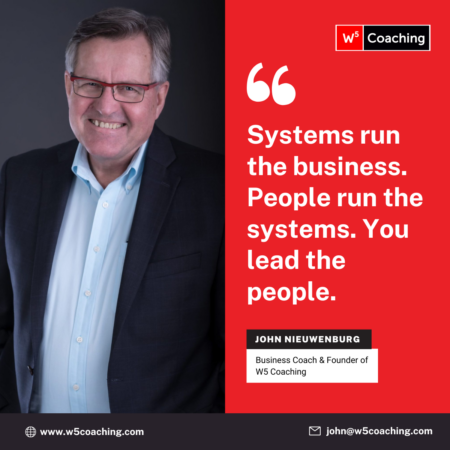
That’s the three-legged stool.
The business can’t rely on you anymore.
And it also can’t rely on people alone, because people come and go.
If your results rise and fall based on who you’ve hired this year, you’re hostage to staffing.
You build them once, teach them to capable people, and they deliver consistently.
Your role shifts from being the hustler to being the leader.
For many owners, this is the first time they’ve really had to think about leadership, communication, and delegation in a serious way.
Sales first. Systems second.
One of the biggest mistakes I see is owners trying to build systems too early.
They obsess over process before they have enough sales to justify any of it.
There’s no point having systems if you don’t have customers.
Early on, your job is to figure out:
- How do I generate leads?
- How do I convert them into customers?
- How do I create consistent demand?
Once you have that, systems become critical, because now you need to deliver reliably and repeatedly.
Systems matter. Just not before sales.
And the level of systemization has to match the scale of the business.
What works at $500K is very different from what works at $5M or $50M.
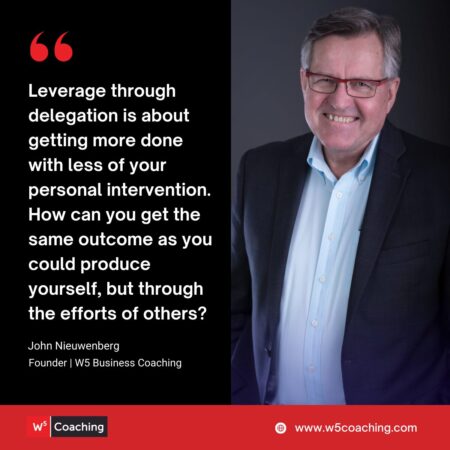
Figure out where you add value. Delegate the rest.
When an owner tells me they’re stuck, I ask one question:
Where are you creating the most value in the business?
Almost always, the answer is:
- being in front of prospects
- converting sales
- and, in some cases, delivering the highest‑value part of the service
Then I ask what they’re doing every week that pulls them away from that work.
Here’s the blunt version:
If you don’t have a virtual assistant, you are the virtual assistant.
And you’re probably not very good at it.
Most owners are spending five, six, even ten hours a week on work that absolutely needs to be done… but shouldn’t be done by them.
Here’s a simple rule of thumb:
Anything that makes you think, “Oh, Sh*it. I have to do this,” or causes you to procrastinate or feel dread, that’s your signal.
It’s time to delegate.
If someone else can do it for $15 an hour, why are you doing it — if it prevents you from doing work worth $300–$500 an hour?
You’re not spending money.
You’re buying back your time.
At first, you’re the reason the business grew. Later, you’re the reason it can’t.
If you keep scaling by adding more work to your own plate, exhaustion and frustration are inevitable.
You’re building the business on your back.
That’s why I keep coming back to this idea:
If the owner wants a better business, the business needs a better owner.
“Better” doesn’t mean working harder. It means thinking differently.
It means finding leverage.
Many owners get stuck because they believe they need to keep 100% of everything.
That mindset caps growth.
Leverage is what allows scale. John Paul Getty said it best:
I’d rather make 1% of a hundred people’s efforts than 100% of my own.
Your effort has a ceiling. Leveraging the efforts of others removes that ceiling.
The question isn’t whether you keep it all.
It’s whether you want to grow.
The question you need to ask yourself about goals and growth
I often hear goals like “I want to get to $12M” or “I want to double the business.”
When I ask why, the answer is usually vague.
That’s because it’s the wrong question.
The real question is:
What do you want your life to look like?
The true purpose of a small business isn’t revenue.
It’s to give its owner the life they want.
Once you know that, the next question becomes:
What does the business need to look like to support that life?
If the goal has a clear “why,” you’ll pay the price. If it doesn’t, you won’t.
Money is just a marker. It’s what the money enables that matters.
If you’re stuck right now, don’t just ask how to get to the next level.
Ask what needs to change about you — how you’re operating, delegating, and leading — to make the next level possible.
The business won’t give you freedom by accident.
You have to build it that way.
Want help building a business that doesn’t depend on you?
If you’re running a founder-led business and feel like everything still runs through you, that’s your signal to change.
At W5 Coaching, I work with owners to:
- get out of the daily bottlenecks
- install practical systems that actually get used
- delegate without losing control
- and build a business that supports the life they want
If that sounds relevant, let’s have a conversation.
Book a call to see if coaching is right for you: book a call with John
Build a Self-Managing Company
How to build a business that runs smoothly, profitably, and (mostly) without you.
Feeling stressed out and overwhelmed with a business that is taking all your time - and not giving you enough in return?
Are you finding it challenging to hire the right team (and get them to do the right things)?
I wrote this little guide for you!
Enter your details below to receive your free copy!