
How W5 Coaching Helps Small Business Owners Get Their Lives Back


John Nieuwenburg was recently interviewed by Adam Torres on the Mission Matters podcast.
You can listen below or scroll down to read the lightly edited transcript.
Adam: John, welcome to the show. To get us kicked off, tell us a little more about yourself. How did you get into the coaching business?
John: I’ve been a coach since 2004, so about twenty-two years. But the other answer, which is also true, is all of my life. It was Steve Jobs who said you can only connect the dots going backwards. About six months into coaching, I had an epiphany one morning and connected some dots and realized, oh my gosh, I’ve always been a coach. In 2004 I just made it more formal and professionally called myself one.
Adam: Take me back in time a bit. Were you always in business? Were you always entrepreneurial?
John: The first 17 years of my career, I worked for a national menswear retailer. I started as a sales guy in a store, and over those 17 years I lived in a bunch of places in Canada. Ultimately I was in Toronto, and after about five years of that, I decided I wanted to get back to Vancouver. I got myself headhunted and became president of BC Liquor Stores, which today does three billion in sales with 200 locations and 4,000 FTEs. It’s a big business, but running a retail chain is like running 200 small businesses that just happen to be assembled under the same roof.
How I left corporate to “row my own canoe” as a coach
Adam: When you decided to go out on your own and get into the coaching space, what was that transition like?
John: It was a time I wanted to row my own canoe. Corporate life was something I wanted to leave behind. So I was focused and driven, but it’s also pretty scary, because when you get into your own canoe, some of the safety nets you have in big corporate life aren’t there anymore. The other side of that coin is you get a lot more freedom to row the canoe in the way that you want. Everything that’s a bit scary has an optimistic side to it.
Adam: What draws you to working with small business owners? There are a lot of things you could do with your time and expertise.
John: I kind of stumbled into it. It wasn’t something I set out to do, but I found a way to start a coaching business, and once I started, I realized I’ve been wired to do this all of my life.
It was a bit of an adjustment going from being the head of something that does three billion to helping small business owners who are more typically doing a million or so in revenue with four, five, six, seven, eight people. So I had to learn what’s on their minds, what their issues are, and what they’re looking to have happen in their lives.
What a small business is actually for
Adam: In your view, what is the purpose of a small business?
John: I’m going to give you an answer that’s a bit counterintuitive, and it wouldn’t be the answer a small business owner would give to their team members, and certainly not to their customers. But the ultimate purpose of a small business is to give its owner the life he or she wants.
Here’s the thing. None of us were born to business. We were born to live. And yet what happens so often for small business owners is they get so wrapped around the axle of their business that the business takes over their life. They mean well, their heart and their mind are in the right place, but they can’t figure out why they’re working seventy hours a week, or what needs to change so they can go see one of their kids’ games or even possibly go for a date night.
Being good at a trade, doesn’t necessarily mean being good at business
Adam: When did you realize this? Because in my mind, the small business owner is the one taking the risk, the one who doesn’t get to check out on the weekend. When did you have that realization, or did you always know?
John: I think I saw it pretty early, because I saw what was happening to business owners.
The kinds of owners I work with are typically one of two kinds. They own a trades business, so they’re electricians and plumbers and other home services businesses. Or they’re professional advisors, so they’re lawyers, accountants, health practitioners. That sounds very different, but what they have in common is that they’re very good at a trade or very good at a profession. It takes five years to become certified as a journeyman electrician, seven years to become a lawyer. What neither of them has ever had is an education in business. So they’re good at a trade, good at a profession, and then find out two, three, four years in that just because you’re good at a trade doesn’t mean you’re good at business.
Sometimes people ask me, “How can you help me? I’m an electrician.” Look, I can’t help you be a better electrician. But that’s not what the problem is. The problem is you want to become better as a business owner. That’s the part you need help with.
“I can’t make payroll tomorrow”
Adam: Where do you find a lot of business owners when you first start working with them? What are the opportunity areas that are obvious to you because you’ve done this for so long, but maybe not obvious to them?
John: I’ll start with an anecdote. One of my first ever clients, I was working with him to build out a strategic and business plan. It came from a very academic point of view: what’s the path, what are we trying to do here? I’d been working with this person for about three or four weeks, and he wasn’t fully engaged, wasn’t really participating. So I stopped and said, “Hey, what’s going on? How come you’re not very engaged in this?” And he looked me square in the face and said, “Well, I don’t know why we’re doing this. I can’t make payroll tomorrow.”
That’s when I realized I was a doofus. Of course a strategic plan was completely irrelevant to him. He was much more concerned about cash flow in the business.
Time, team, and money
So every business owner I work with starts with problems around time, team, and money. Time sounds like: I’ve got too much to do and not enough time to do it. I can’t get everything done. If I don’t do it, it won’t get done. That’s a lot of what a small business owner is saying to themselves. Team is about recruiting, getting good team members, getting the culture you want, getting people to work at the standard that you want. And money is both getting proper financials, accounting, reporting, understanding what the numbers mean, and also wanting more money, wanting to get better at sales and marketing.
If you’re a business owner and you’re not complaining about one or all of those three things, we probably don’t have anything to talk about. But most business owners I come across very much relate to what I’m describing.
I sometimes like to ask business owners, “How many people have you got?” They say ten. Then I ask, “If you could start from scratch, how many of the ten would you rehire?”
Adam: Wow. That’s a great question.
John: The most common answer I get is about half. So then I ask: do you mean the bottom half of your team is annoying the top half? What happens if we can get the bottom half to be at least average? How would that help you with your customers? How would that make your life better?
It’s an example of how we tolerate stuff that we shouldn’t tolerate. And at the end of the day, whatever it is you’re tolerating is the actual true statement of your culture. If you want your life to get better, find a way to get better people and get them into better positions so that they can do work at the level you need.
The hub and spoke problem
Adam: Switching focus slightly. Why is it a trap to be a hub and spoke leader?
John: It’s a metaphor, of course. Think about a bicycle wheel, and the centre is a hub. For most business owners, that hub is the owner themselves. They’re the very centre of the business. The spokes are all the things everyone is tugging at your elbow about: “What do you want me to do here?” “What decision should I make?” “How are you going to help me with that problem?” Everything that happens in the business, in one way or another, has to go through the hub. And the hub is you.
Now imagine that in this bicycle wheel we took out the hub. What would happen to the wheel?
Adam: It wouldn’t be a wheel at all.
John: Exactly. So the difficult transition for most business owners is to stop thinking of themselves as the owner/operator and start thinking of themselves as the leader/owner.
Let me give you another metaphor. Let’s say you’re a captain in the Navy. You’re on a 50-foot boat, the crew is 10, and you, the captain, are the most qualified engine room guy. How often is that captain in the engine room? All the time.
All right, now let’s make you the captain of a 150-foot boat, and the crew is 50. How often should that captain be in the engine room? Well, maybe if there’s a fire.
That transition from the 50-foot to the 150-foot boat takes a complete shift in the lens and the way that you think about your role and the way you lead or operate that business. That’s the trap. You’re still stuck in the hub and spoke, and that’s why you’re working 70 hours a week.
Why I don’t start with planning
Adam: So somebody’s listening to this right now, and it’s resonating, and they’re thinking, “Man, he’s talking about me.” How do you start that transition?
John: Every business owner I start with comes to a business coach because they have what I call a burning bush.
I gave you one example, the guy who couldn’t make payroll. Another example is the guy working seventy hours a week who hasn’t been able to get to one of his kids’ games, and he’s had enough. Or someone recognizes, “Oh my gosh, I need to get a hundred thousand dollars more in sales in the next three months.”
So the way we start is always by fixing the thing. Fix the burning bush. Let’s agree on what the burning bush is for you, we’ll solve for that, and that might take six weeks or two or three months. Once we do that, we can catch our breath and decide, okay, now let’s do this in a systematic, organized, structured way.
What I’ve learned is that you don’t even bother trying to do that until you’ve fixed the burning bush.
Why it’s called W5
Adam: That makes a lot of sense. Last question, or really a two-part question. How do people connect with you at W5 Coaching, and what type of business owners get the most value out of working with you and your team?
John: First, a little story about the name. I help business owners figure things out for themselves, and you do that by asking great questions and helping them think out loud. The core questions all start with a W: who, what, when, where, and why. So if you’re wondering how to find me, go to w5coaching.com.
As for who gets the most value, they’re typically doing something like a million, two million, three million dollars. They’re often trades businesses, so electricians and plumbers and home services businesses. They’re guys who started with one truck, two trucks, and now they have five, six, seven trucks, and things aren’t working the way that they wanted.
The other kind of business is professional advisors, and by that I mean lawyers, accountants, health practitioners. What they all have in common is that they offer professional advice. The advice, of course, is different, but the business owner challenges are very common to both.
If any of this sounds familiar, let’s talk.
If you recognize yourself in this conversation, the hub and spoke, the seventy-hour weeks, the team you’d only half rehire, that’s the work I do every day with owners like you. Book a time to talk with me at: book a call with John
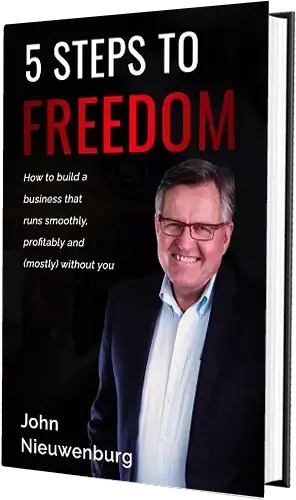
Build a Self-Managing Company
How to build a business that runs smoothly, profitably, and (mostly) without you.
Feeling stressed out and overwhelmed with a business that is taking all your time - and not giving you enough in return?
Are you finding it challenging to hire the right team (and get them to do the right things)?
I wrote this little guide for you!
Enter your details below to receive your free copy!