
Stuck in the Middle of Everything? It’s Time to Become a Leader Owner.

John Nieuwenburg
John Nieuwenburg has been a professional business coach since 2004. Prior to becoming a coach, he held executive positions with Tip Top Tailors and BC Liquor Stores. In 2019, MacKay CEO Forums awarded him with Canada’s CEO Trusted Advisor Award in the Small Business category. Since becoming a coach, John has worked with over 400 clients, taking them through a systematic process that helps them feel organized, confident and in control of their businesses.
Have you outgrown your role in your business?
Does any of this sound familiar?
You built a business that works.
But it only works because you’re in the middle of everything.
You’re the one answering questions, making decisions, putting out fires, and then doing the actual work of the business on nights and weekends.
You’re working 60 or 70 hours a week, you can’t seem to hire people who don’t need constant supervision, and somewhere along the way your family started competing with your business for your attention.
Here’s the part nobody tells you: the problem isn’t your people, your systems, or your market. The problem is that you’ve outgrown your role but haven’t changed how you operate in it.
You’re still running your business like an operator – doing and deciding everything – when what your business actually needs is a leader.
And that’s good news, because it means the solution starts with you.
In this video, I walk through the evolution every business owner goes through and shows you why the stage you’re in right now is the hardest one to break out of – and what it actually takes to make the shift.
Here’s what you’ll take away from this one:
- The five stages of the owner evolution, and how to figure out which one you’re actually in (not which one you think you’re in)
- Why the shift from operator to leader is the hardest move you’ll make – and what makes it so different from every stage before it
- The real story of a factory owner who was in his car by 4:30 every morning for ten years and what finally made him change
- The identity shift that keeps owners stuck (and the specific language pattern that reveals it)
- An honest answer to “What’s the purpose of my business?” (you won’t put this one on your website, but you might tell your spouse)
Getting to the next level isn’t about working harder or hiring more people.
It’s about how you think about yourself and your role. And why that’s the thing that has to change first.
You can watch the video or read the transcript below:
If You Want a Better Business, First the Business Needs a Better Owner
So our question today is, why does your business need a better owner?
And let me reframe that. If the owner wants a better business, first the business needs a better owner. And of course, that’s you.
Ultimately, the results you get in your business are a reflection of how good you are as a business owner. So we start this conversation with a thought: how do you become a better business owner?
The Owner Evolution: Where Are You on the Ladder?
Let’s talk about the owner evolution and help you identify where you might be.
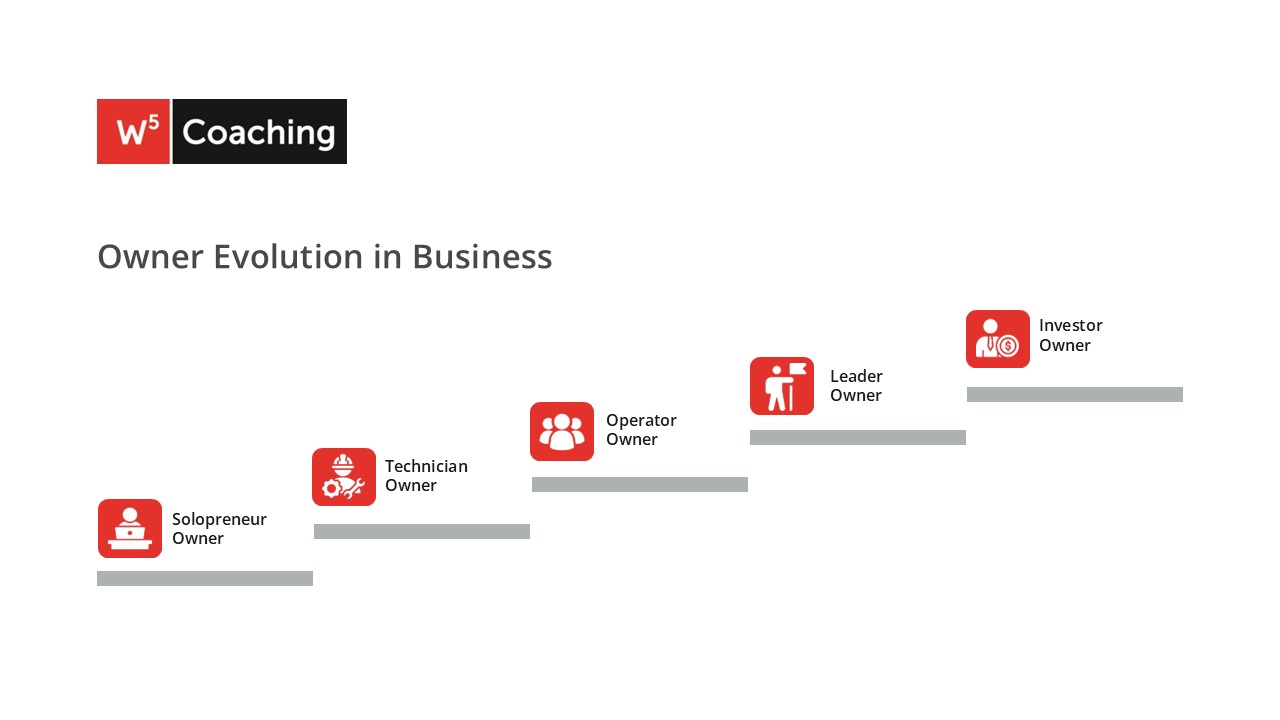
You might have started in a different place, but typically one of the pathways people follow is starting as a solopreneur.
You might be a plumber with a truck, or a consultant, or an electrician.
You’re getting phone calls in the morning and driving off to take care of business.
That works for a while. Then you’re getting so busy that you think, “I need a helper. I need someone who helps me in the work.”
So you hire an apprentice, and maybe that means two trucks, because now it’s getting busier and busier.
Congratulations, you’re now a technician owner.
You’re still working in the business. You’re still operating tools every day.
But at night you’re doing payroll, you’re doing payables, you’re collecting, you’re wondering how come you can’t get quotes out the door.
That continues to grow and now you’ve got 10 trucks and eight or nine or ten people.
But everything that happens in the business happens because somebody asks you something or you tell someone to do something.
You’re the hub. You’re the operator. Everything depends on you. That’s a hard place to be.
The Shift to Leader Owner
The next step in that evolution is where you think of yourself as the leader owner.
What does that mean?
It means all of the things that everyone depended on you to do in the business are now going to be someone else’s responsibility — not yours.
Everything the business produces, someone apart from you has got the name or the label or the responsibility of delivering it.
You’ve got someone in charge of finance. You’ve got someone in charge of HR. You’ve got someone in charge of delivering the services you provide — not you.
When they have a question, they’re not phoning you. They’re phoning the operations manager or whatever title you give that role.
The shift is from “If it’s to be, it’s up to me” to “If it’s to be, it’s going to be done by someone else, but I’m holding that person accountable.”
You’re the one who sets the goals. You’re coordinating their efforts.
But everything the business produces is produced by someone else.
Then ultimately, there’s the investor owner.
The investor owner is in the business as little or as much as they choose.
Largely what that means is you’re responsible for strategy and capital allocation — is it time to renovate, get a different office — but you’re no longer involved in the day-to-day at any level.
Your role is to be the captain of the ship.
Why the Operator-to-Leader Shift Is the Hardest One
The shift between the operator level and the leader level is actually the hardest one to make. At the operator level, everything depends on you.
And what does that feel like?
You’re thinking, “I’m working 70 hours a week and I don’t know why, but I can’t get everything done because I have no time during the day to actually do stuff.”
So you’re doing books on the weekend. You’re doing quotes at night. You’re probably thinking, “How come I can’t hire good people?”
Or when you do hire them, you can’t get them to do a good job. They need constant supervision. They’re always phoning you or asking you for help.
And you’re not even that happy with the culture you have. And then there’s money, which has two components.
One part is, “Do I understand what’s happening in the business? Do I have a dashboard? Do I have a P&L I understand? Do I have enough cash flowing through the business?”
The other side is, “I need or want more money. I need better sales and marketing.” You’re quite likely complaining about one or all three of those things — time, team, and money.
Fred’s Story: Chained to the Business for Ten Years
Let me tell you a story about a client of mine — a real story — at a factory. He had two shifts, starting at 6:00 in the morning and finishing at 10:00 at night.
Fred was the owner-operator.
That meant nothing could get done unless somebody asked Fred a question. Every time there was an exception or a change needed, Fred was in the middle of it.
He’d go to the gym — he’s a big workout guy — and he’s wondering how come he can’t do a whole set without getting ten phone calls. He felt like he was chained to the business.
And here’s the thing: he had to be in the business the whole time.
That meant he had to be there at six o’clock and he had to be there at 10:00. He might leave at 9:00, but he lived an hour’s drive away.
So he’d leave the factory at 10:00, get home around 11:00, get to bed, and then he’s up at around 4:30, driving to make it back for the start of the first shift.
He did this for 10 years. He was prepared to pay the price. What did he know how to do? Be stubborn. Just persevere. “I can do this. This is what is needed of me. This is what it’s going to take.”
Until something shifted.
What literally happened in Fred’s case is one day his wife said to him, “Your business is your mistress. If you don’t do something about it, I will.”
That caused Fred to think, “I’m not prepared to pay that price.”
He didn’t want anyone to think his business was his mistress, and he certainly didn’t want to give up his life and his family and his wife. Something had to change.
“I don’t know what to change.” And that’s when this really stubborn, persistent kind of guy said, “I don’t know how to do anything different. I need to get some help.”
What Had to Change: It Wasn’t His People. It Was His Leadership.
He called me and we had a meeting in his office and came to understand what he was trying to solve.
Essentially it was this: how do I get from being an owner-operator to being a leader owner so that the factory can function without my minute-to-minute, hour-by-hour involvement?
Over the course of a couple of years, Fred started to recognize that he was the problem.
The problem wasn’t that he had bad people.
The problem was that his people had a bad leader.
He had to shift how he thought about things. He had to learn how to become better as a leader, better as a communicator, and better at understanding what delegation actually really meant.
He thought delegation meant, “I tell you to do something, you do it, you come back and tell me it’s done.”
What he had to learn was to delegate autonomy and authority. “This is your area of responsibility. 85% of what happens in that area ought to be routine, systematized — this is how we do it. 15% of the time something’s going to happen or you need my help. On that 15%, I ask — I demand — that you come and talk to me.”
“Well, how do I know what you’re doing and how you’re going about it?”
Instead of relying on instructions minute-by-minute, hour-by-hour, they agreed on SOPs. They agreed on checklists. They agreed on how they could work together with shared standards.
And Fred got to a place where he had the peace of mind to know that while he was not in the factory, the factory was still operating in a way that met his expectations.
Because instead of relying on those phone calls back and forth or the “Hey, got a minute, Fred?” interruptions, both his team and he knew they could rely on what they’d agreed were the standards.
But here’s the real thing.
Fred got his life back. His level of stress diminished. He had time to do the things he wanted to do and he no longer felt handcuffed or chained to his business.
The most important thing Fred would tell you is that he got his life back.
Same Title, Completely Different Job
So let’s pretend you’re a captain in the Navy.
You’re the most qualified engine room guy — that’s your background, your expertise, your training. The boat is 50 feet and the crew is 10.
Because you’re the most qualified engine room guy, how often are you in the engine room with tools? All the time. You’re the guy. Maybe you’ve got a helper, but he’s kind of an apprentice-level guy. You’re the master.
Now, let’s make you a captain of a 150-foot boat with 50 people. How often should that captain be in the engine room at all? Almost never. And almost never with tools. Maybe the only exception is if there’s a fire in the engine room.
Because now that captain has to rely on getting results through the effort of someone who’s now the engine room guy — and that engine room guy may have two or three helpers.
That role changed, hasn’t it? “I can’t be the doer of the engine room.
I’ve got to be the leader of the people that do the engine room and every other aspect of the boat.”
Now, let’s make you a captain of an aircraft carrier. Two thousand people on board. How often is that captain in the engine room? I’m going to bet the only time is when someone’s getting a 20-year certificate. It’s an official ceremony.
Because now that captain has a person who manages the person who’s the engine room guy. They’re three levels removed. That captain has a very different role, a different identity, different skills than a captain of a 50-foot boat.
And that transition is a metaphor for what it means to go from level one to level five.
The hardest part is going from the 50-foot boat to the 150-foot boat.
The Identity Shift That Keeps You Stuck
Because in fact, the change that happens starts with how you identify yourself.
What you think of as your identity.
Our identity is the things we say to ourselves about ourselves when no one else is looking.
Our identity is anything we say with “I am,” “I can’t,” or “I can.” “I am a great salesperson.” “I’m a great coach.” “I can’t play golf.”
Those are examples of how we identify our identity.
Here’s the thing.
Right now you might be saying to yourself, “I’m an electrician and I own a business.” Or “I’m a plumber and I own a business.” Or “I’m a lawyer and I own a firm.”
As long as you say that to yourself, you’ll be stuck at the operator level.
What’s the shift? “I’m a business owner. Happens to do plumbing.” “I’m a business owner that does electrical work.”
What changed?
It’s not you at the center anymore. The business is at the center.
You’re leading the people.
You can’t get that behavior until you make that shift and recognize, “No, I’m not an electrician. I’m a business owner.”
And now your job is leadership, communication, and delegation.
Your job is to set the tone, hold people accountable, have metrics in place, have a reporting system that everybody can look at and know whether they’re on track or not.
The Purpose of Your Business (The Answer You’d Tell Your Spouse)
What’s the purpose of your business?
I’m going to give you an answer.
But before I do, let me tell you that this answer isn’t going to be the same one a guy owning a $100 million or a billion dollar business would give.
And it isn’t going to be the answer you tell your team, your vendors, or your customers.
But it will be the answer you tell your spouse.
The purpose of a business like yours is to give you the life you want.
None of us were born to business.
We were born to live.
And so many times what happens is we get so wrapped around the axle of our business that it takes over our life and every other aspect of our life suffers as a result.
I had a client this morning who started the session by saying, “I didn’t do my homework, but it’s been a very difficult week. My wife from time to time gets upset that I spend so much time in the business that I don’t have time for her or the family.”
But he doesn’t know what to do differently.
He doesn’t know how to change or adjust his thinking so that he is available and present for his family.
Your business is a vehicle to give you the life you want.
Let’s get clear about what life you want for yourself and your family.
And then we can answer the question: what does the business have to look like so I get that life?
When you’re clear — like Fred was clear that he wasn’t prepared to pay the price of having his life disrupted — that’s when you decide it’s worth changing how you think of yourself and what you do as a business owner.
I hope that thought appeals to you.
I hope you recognize yourself in that.
Yes, I do want to live my life the way I want. I want to have time for my family, my kids, my hobbies, my interests, my friends — and that my business is producing that for me.
Ready to make the shift from operator to leader owner?
If you recognized yourself in this post, coaching can help you get there faster. Together, we’ll work on the mindset, the delegation, and the structure that lets your business run without you in the middle of everything.
Book a confidential, complimentary 15-minute call to find out if coaching is the right fit for you: Book a call with John
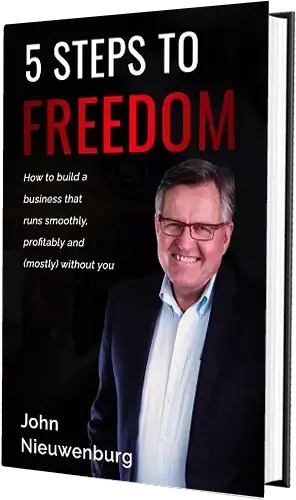
Build a Self-Managing Company
How to build a business that runs smoothly, profitably, and (mostly) without you.
Feeling stressed out and overwhelmed with a business that is taking all your time - and not giving you enough in return?
Are you finding it challenging to hire the right team (and get them to do the right things)?
I wrote this little guide for you!
Enter your details below to receive your free copy!