
How to Delegate Decision Making (Not Just Tasks)


John Nieuwenburg
John Nieuwenburg has been a professional business coach since 2004. Prior to becoming a coach, he held executive positions with Tip Top Tailors and BC Liquor Stores. In 2019, MacKay CEO Forums awarded him with Canada’s CEO Trusted Advisor Award in the Small Business category. Since becoming a coach, John has worked with over 400 clients, taking them through a systematic process that helps them feel organized, confident and in control of their businesses.
Why your team can’t move without you (and what to do about it)
You’ve got a team.
You’ve hired people.
You’re paying them to handle things.
So why are you still making every decision?
I’ve been coaching business owners for over 20 years.
One of the most common things I see is this:
they’ve delegated the work, but kept all the judgment for themselves.
There’s a critical difference between the two.
And until you understand it, you’ll stay stuck in the middle of your business, the hub everyone else revolves around.
That’s a recipe for exhaustion.
And it’s quietly putting a ceiling on your growth.
Not All Decisions Are Created Equal
Here’s a simple framework I find useful.
Every decision you make fits into one of three categories.
Hats. Put it on, take it off, try a different one. Low consequence, easily reversible. Most day-to-day calls are hats.
Haircuts. You’ll live with it for a while. Reversible eventually, but not overnight.
Tattoos. Long-term, expensive to undo. These deserve your full attention and real deliberate thought.
The problem isn’t that owners make bad tattoo decisions.
The problem is they spend enormous energy treating hats like tattoos — then wonder why they’re exhausted at the end of the day.
Your team can handle hats.
In most cases, they can handle haircuts too.
Your job is to focus on the tattoos.
Decision Fatigue Isn’t a Time Problem. It’s a Leadership Problem
I’ve written before about the hub-and-spoke trap.
When you’re the hub, nothing moves without you.
Every spoke connects back to the center.
And the moment you’re overwhelmed (or on vacation, or sick) the whole wheel stops turning.
Most owners I work with don’t realize they’ve built this structure.
They think the problem is that they need better people, or more hours in the day.
But the real issue is that they’ve never designed a business where decisions can happen without them.
When other people’s urgency determines what you respond to, you’re not leading.
You’re reacting.
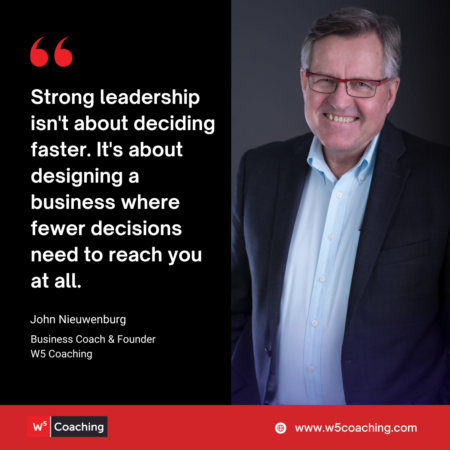
Strong leadership isn’t about answering faster.
It’s about designing a business where fewer decisions need to reach you at all.
The Real Problem With Decision Delegation (Hint: it’s Not Trust)
When delegation breaks down, most owners assume it’s a trust issue.
They hired the wrong person.
Their team isn’t ready.
Nobody does it the way they would.
In my experience, that’s almost never the actual problem.
It’s a decision design problem.
Here’s an example.
I worked with a construction company owner whose office manager was handling invoicing.
Customers pushed back.
Discounts were requested.
Every time, the decision landed back on his desk.
Not because the office manager couldn’t handle it, but because she’d never been told she could.
We didn’t change the person.
We changed the structure.
“You have authority up to $250. Make the call. Don’t ask me first. Tell me what you decided at our weekly check-in.”
She hesitated because she didn’t want to “give away the money.”
That hesitation was a sign that she had good judgment.
She just needed permission and a boundary to work within.
What changed wasn’t trust.
What changed was decision ownership.
This is the shift most owners miss.
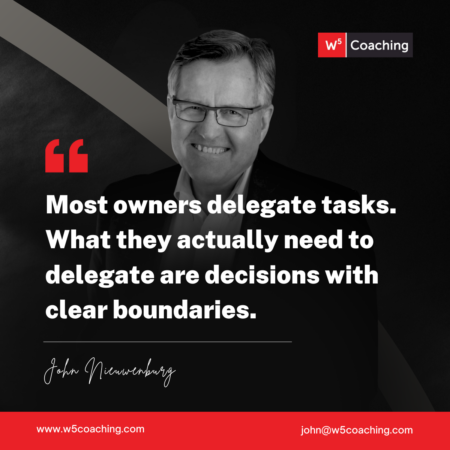
They delegate tasks.
What they actually need to delegate are decisions with clear boundaries.
The Right Level of Delegation Depends on the Person and the Situation
I’ve written about levels of delegation before, and it’s worth applying that thinking here.
A new employee handling customer complaints for the first time probably needs:
“Here’s what’s in bounds. Check with me before going further.”
But someone who’s been doing it for two years?
They should be at:
“Make the call. It’s your area. Let me know if there’s an exception.”
Same role, very different level of authority.
And both are appropriate at different stages.
The mistake is treating everyone at level one forever because you never had the conversation about moving up.
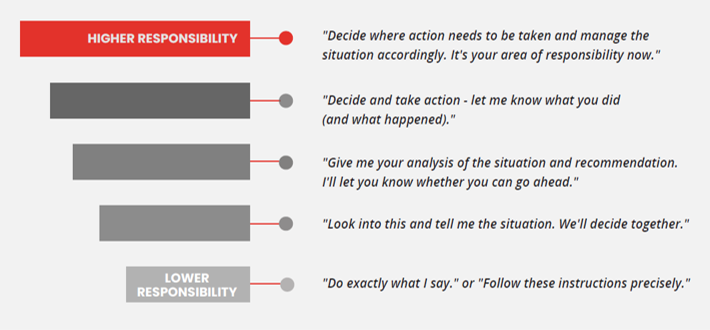
Show people the scale.
Ask them where they think they sit.
Most of the time, they know.
And having that mutual understanding changes everything.
Great Leaders Make Fewer Decisions, Not Faster Ones
Jeff Bezos once said that if he makes three or four good decisions in a year, it’s a great year.
That sounds absurd until you think about what kind of decisions he’s talking about.
He’s not deciding which button to put on a webpage.
He’s deciding what will still be true in ten years.
Those are tattoo-level decisions.
Everything else flows from them.
The real discipline of leadership is deciding what deserves your decision at all.
Not just getting better at deciding.
Your intuition plays a role here too.
After years in your business, you develop pattern recognition.
You know when something’s off.
You know when a deal is real.
The worst decisions I’ve made weren’t analytical failures.
They were moments when I ignored something I already knew, because acting on it would have been uncomfortable.
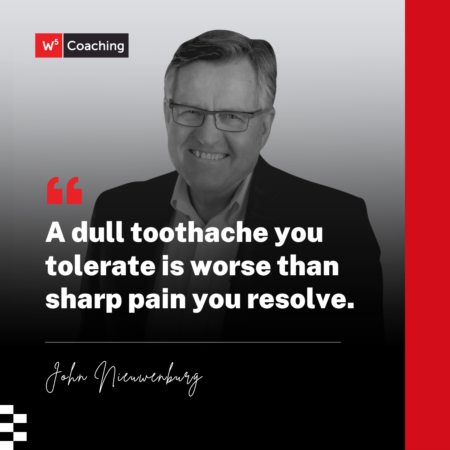
A dull toothache you tolerate is worse than sharp pain you resolve.
That applies to people, structure, strategy, and leadership.
The Executive Shift
At some point, every owner with a team faces the same choice: keep being the decision hub for everything, or design a business where most decisions never reach you.
This is what I call the shift from operator owner to leader owner.
And it’s not just a mindset change — it requires deliberate structural work.
It means defining decision rights.
It means setting clear boundaries (“you have authority up to X, here’s what to escalate”).
It means running check-in meetings where your team reports what they decided — not asks for permission.
When that shift happens, something changes.
The business gets calmer.
Your team gets stronger.
And you finally have the space to focus on the decisions that actually matter — the few tattoos that shape everything else.
That’s what it means to lead.
If you’re ready to make this shift but not sure where to start, let’s talk.
Book a complimentary 15 minutes with me here: Book a call with John
Get Your Time Back
How to escape overwhelm and gain time freedom in your business

Get control of your email and calendar
-
Prioritize your most important tasks
-
Become more productive than you ever thought possible

Ready to free up 5-7 hours per week? Download this guide today! Enter your details below to receive your free copy!