
Take Back Your Time


John Nieuwenburg
John Nieuwenburg has been a professional business coach since 2004. Prior to becoming a coach, he held executive positions with Tip Top Tailors and BC Liquor Stores. In 2019, MacKay CEO Forums awarded him with Canada’s CEO Trusted Advisor Award in the Small Business category. Since becoming a coach, John has worked with over 400 clients, taking them through a systematic process that helps them feel organized, confident and in control of their businesses.
Every owner I begin working with comes in feeling like they’re working way too much and don’t really have any control over their time.
Maybe you can relate to this situation:
Even though you’ve hired a team, you’re still the busiest person in the building.
Every decision runs through you.
Every “quick question” ends up on your desk.
Vacation doesn’t feel like vacation, because the phone still rings.
If that sounds familiar, you might imagine this to be a problem that could be solved with better time management.
This video will show you a different way to think about it.
Discover:
- Why what you’re experiencing is actually a leadership and structure problem (and the three specific shifts you need to make to fix it)
- Why “delegating tasks” is keeping you as the bottleneck, and what to hand off instead
- The difference between being available and being accessible, and why one of them is costing you your week
- The simple 1-3-1 Rule you can use to stop being “the answer machine” for your team
Watch the video or scroll down to read the transcript.
You Don’t Have a Time Management Problem
Today I want to talk with you, the business owner, about how to get your time back. Every time I start with a new client, they feel like they’re working way too much and don’t really have control over their time. You have a team. You’ve hired people, and somehow you’re still the busiest person in the building. Your phone pings, rings, and dings constantly. People stop by with all the questions that you might have. Everything that requires a decision requires your input. You’ve been on vacation, but it never really feels like a vacation, because you’re still getting phone calls three, four, ten times a day. You’re working 70 hours a week, and you’re asking yourself: How come I’m still not getting everything done? How come everything feels so hard? Why is this so difficult?
Here’s the thing: you don’t really have a time management problem. What you have is a leadership and structure problem.
What do I mean by that? You’re delegating tasks instead of responsibility. You’re the hub and spoke. Think about a bicycle wheel, with the hub at the center and the spokes holding it together. Without the hub, the wheel doesn’t exist. That hub is you. Without you, the business doesn’t exist. It’s so dependent on you that the team is actually trained to interrupt you, because they know that every time they hit something they can’t solve on their own, they need to come talk to you. And when they do, you take on the decision and tell them what to do.
So what do you need to do differently? There are three shifts.
Shift One: Delegate Outcomes, Not Tasks
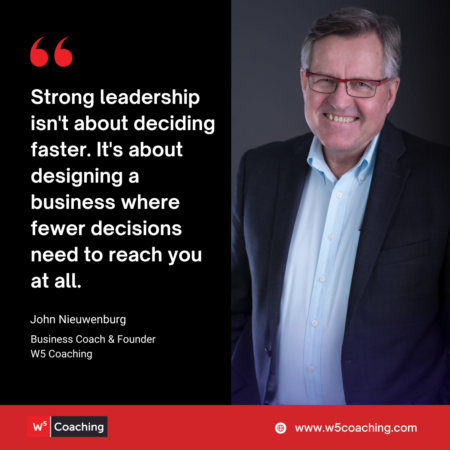
The first shift is that instead of delegating tasks, you have to delegate outcomes.
When I was president of a very large organization, I had about ten people reporting to me. Nine of them had jobs where they were better at their function than I was. What could I tell the CFO about how to do accounting? What could I tell the marketing person, or the HR person? I was an expert in one area of the business, and in that area I knew the mechanics, the ins and outs, the nuts and bolts. But I came to realize I couldn’t tell any of them what to do. I couldn’t even tell them how to do it. What I could agree on was the result: here’s the outcome we’re looking for. How you get there is up to you. If you want help thinking it through, of course I’ll help. But you’re the expert, and I’m depending on you to deliver the outcome we’ve agreed is required.
The difference is that I’m delegating autonomy and authority. You’re in charge. It’s your call. Don’t come to me asking what you should do today, because I don’t know. As long as you’re delegating tasks, do the books, go put in the new heat pump at Fred’s, let me know if there’s a problem, everything still runs through you. And that’s the definition of an owner-operator: if anything happens in the business, it’s because of your direct involvement.
What needs to shift is becoming a leader-owner. That means you get the outcomes the business needs through the efforts of others. You hold people accountable for results, and they’re free to figure out how to get there.
Shift Two: Protect the Culture, Not Just the Outcome
The second part of the direction I gave my team was simple: you couldn’t do anything that would be embarrassing if it showed up on the front page of the paper. That’s a crude way of putting it, but what it really meant was doing things in a way that supported the culture, held our values, and stood for what we stood for. Those were the only two rules I gave: deliver the outcome, and do it in a way we’d be proud of.
That’s the shift, away from a business where everything depends on you, toward one where each function has someone named and responsible for the outcome, while you set direction from the top.
Shift Three: Be Accessible, Not Available
The third shift is how you let people interact with you.
Right now, you probably think of yourself as available. I’d urge you to think of yourself instead as accessible. Those sound like the same thing, but for this conversation I want to draw a distinction.
When you’re available, you’re available on other people’s terms. They can knock on your door, phone you, ping you, and whenever they decide they need you, you’re interrupted. You’re always on call. You’re the firefighter.
When you’re accessible, you’re accessible on your terms. You put boundaries around when you’re available. In a hypothetical model, you might be available at 8, 10, noon, 2, and 4, thirty minutes each time, for checking your inbox, your phone, your Slack, whatever. After that thirty minutes, you’re not available for the next ninety. During that time, you do whatever you want, uninterrupted: invoicing, calls, whatever you decide. That gives you five ninety-minute blocks a day, five days a week. Twenty-five blocks a week that are yours to direct.
In real life, six or seven or eight of those blocks are probably team meetings and routine work, and one block a day probably handles the day-to-day emails and tasks. But that still leaves about three ninety-minute blocks a day for the work you’ve decided matters, the work you never get to, because you never have time, and you never have time because other people are dictating how you spend it. The moment you decide you’re going to dictate how you spend your time and where you put your focus, that’s when the change happens.
Teach Your Team to Think: The 1-3-1 Rule
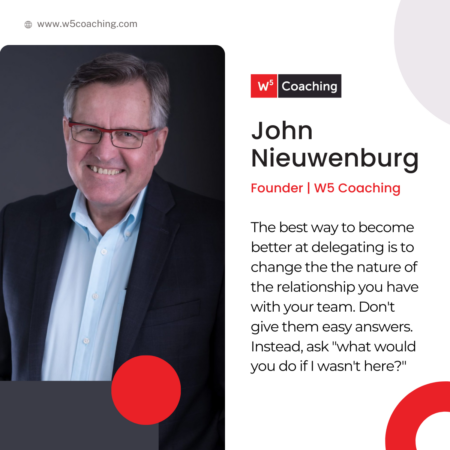
The other shift is in how you work with your team. Right now, a team member brings you a problem, you give them a decision, and they walk out happy. But who owns the cognitive load? Who used their brain to find the answer? You did. You told them what to do.
Instead, teach them how to think. Here’s the rule: 1-3-1. When someone comes into your office, they get one sentence, two or three at most, to describe the problem. Then they tell you three different ways they’ve thought about solving it. Then they tell you which of the three they recommend. Now you get to coach them, help them, even contradict them, but they’ve already done the heavy thinking. Your job is to coach, not decide.
Over time, they’ll come to you less and less, because you’ve taught them how to think. They no longer need you to tell them what to do. I have a client who made a banner that says “1-3-1. Want to talk? Great. Remember the rule.” She hung it in her doorframe, so anyone who wanted in had to duck under it or push it aside. It worked for her team, and it worked for her too. It held her accountable to not slip back into the hub-and-spoke mindset.
The Payoff
Getting out of the hub and spoke is the first step toward becoming a leader-owner instead of an operator-owner. What does it give you? Less stress. Time to actually think about your business. Better decisions, because you have room to make them. Better outcomes and results. A more capable team. And a business that’s actually possible to grow.
What part of that isn’t worth considering?
Jim Rohn, the business philosopher, put it this way:
“Time is more valuable than money. You can get more money, but you can’t get more time.”
None of this happens until you shift how you think about your own job, from I’m the go-to, I’m the hub, I’m the doer, to I’m the leader. I’m the person who leads people to the outcomes we’re after.
—
If you’d like some support implementing these 3 shifts in your business, click here to book 15 minutes on my calendar: book a call with John
Get Your Time Back
How to escape overwhelm and gain time freedom in your business

Get control of your email and calendar
-
Prioritize your most important tasks
-
Become more productive than you ever thought possible

Ready to free up 5-7 hours per week? Download this guide today! Enter your details below to receive your free copy!