
Staying Accessible Without Losing Control


Why Smart Business Owners Set Boundaries Around Interruption
Most small business owners feel stuck between two bad options.
Either you stay accessible and responsive — which usually means spending your day reacting to emails, texts, calls, and questions as they come in.
Or you try to protect your time and focus — and end up feeling guilty, unavailable, or worried that you’re frustrating your team or customers.
It feels like a tradeoff.
But that framing misses the real problem.
The issue isn’t accessibility.
It’s interruption.
The constant rings, pings, and dings that pull you out of your thinking and keep you in reaction mode all day long.
Why Time Management Advice Falls Short
Most time management advice is built around planning.
- Better calendars.
- Clearer priorities.
- Smarter task systems.
Those tools are useful. But they don’t solve the problem most owners are actually dealing with.
They assume that once you plan your day, the day will follow the plan.
If you run a small business, you know that’s not how it works.
Your day is shaped less by what you planned and more by what shows up:
- Emails that need a decision
- Team members who need clarity
- Customer issues that need attention
- “Quick questions” that aren’t actually quick
Interruption isn’t an occasional disruption.
For most owners, it’s the environment you work in.
Trying to manage time without addressing interruption is like trying to organize your papers while the wind keeps blowing the door open.
The Problem Underneath: Boundaries, Not Productivity

This isn’t really a productivity issue.
It’s a boundary issue.
When interruptions are unstructured, a few predictable things happen:
- You make decisions reactively instead of deliberately
- Important thinking gets crowded out by urgent noise
- You become the bottleneck for everything
- Your team learns that urgency is what gets your attention
Over time, this is exhausting — and it makes the business more dependent on you, not less.
The solution isn’t disappearing or becoming less responsive.
It’s being clear and intentional about when and how interruptions are handled.
A Simple Shift: Bundle Your Interruptions
You can’t eliminate interruptions. That’s not realistic.
But you can contain them.
Instead of responding all day long, handle incoming communication in specific, scheduled windows.
That sounds rigid on paper, but in practice it creates flexibility.
Rather than being constantly interruptible, you decide when interruptions are allowed into your day and what happens when they do. That one shift changes everything.
Here’s how it works in practice.
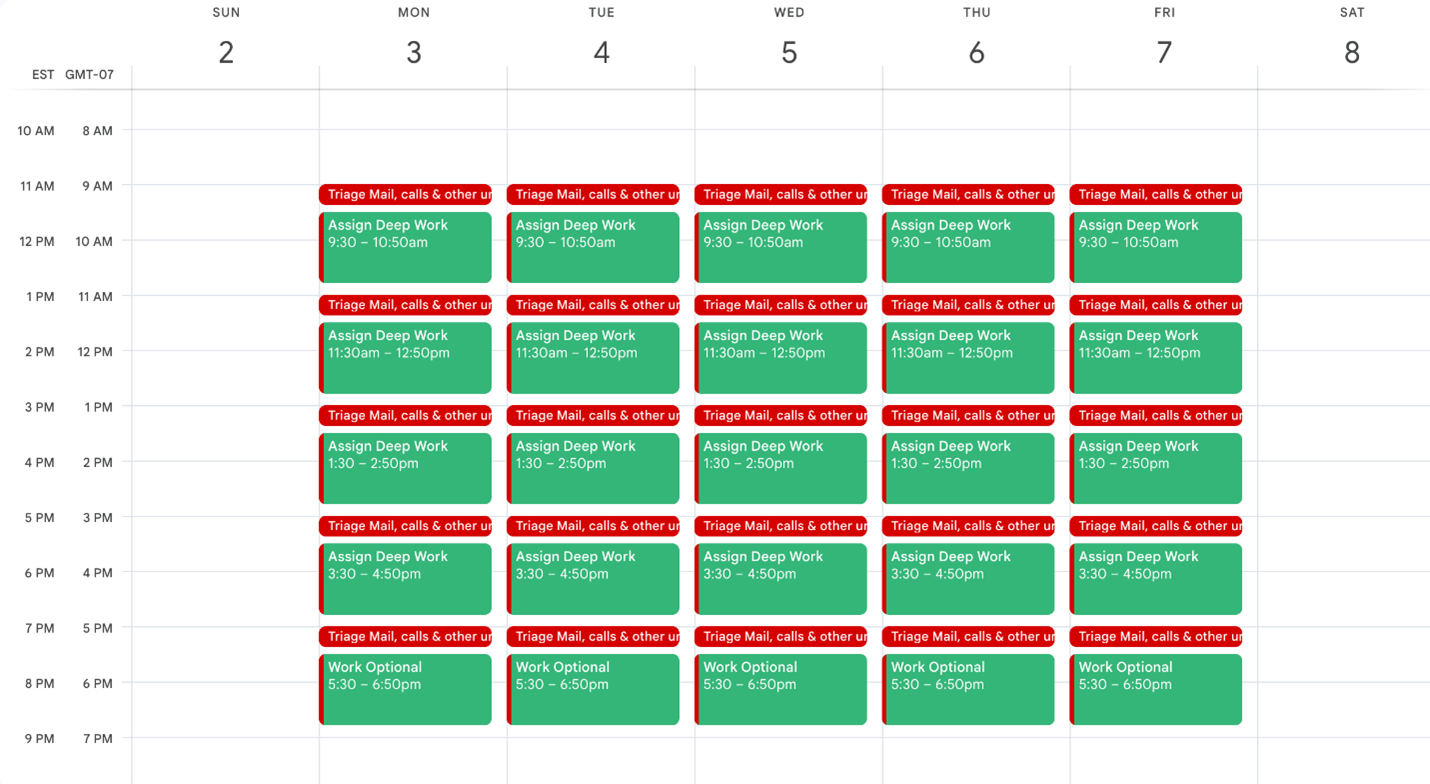
The system has five parts that work together:
- A clear definition of when you’re available
- A simple way for your team to bring things to you
- Regular triage windows to process incoming work
- Protected focus time to actually do the thinking
- A clear line for what counts as an emergency
None of these work on their own.
Together, they replace constant reaction with a predictable rhythm — without making you hard to reach.
1. Decide how work gets to you — and when

Instead of letting interruptions arrive whenever they want, proactively block time on your calendar:
You time block only three things:
- Triage windows
Short, clearly labeled blocks (e.g. “Email + Team Questions”) - Focus blocks
Protected time for thinking, focused work, and decision-making - Hard commitments
Meetings, calls, and obligations that can’t move
That’s it.
You are not trying to time block your entire day down to the minute. That’s where most time-blocking systems fall apart for owners.
The calendar’s job here is simple:
- show when interruption is allowed
- show when thinking is protected
If it does that, it’s working.
2. Set Expectations With Your Team
The system only works if your team understands how and when they get access to you.
If you don’t explain it, they’ll fill in the gaps themselves — usually by interrupting more often “just to be safe.”
The conversation doesn’t need to be long or dramatic. It needs to be clear.
What you’re really telling them is:
- When you check messages and questions
- How you want things brought to you
- What should wait
- What actually counts as urgent
In plain language, it often sounds like this:
“I’m still available, just not all day long. I’m checking messages at specific times so I can think and make better decisions. If something isn’t urgent, it goes into the next window. If it is urgent, here’s what that means — and here’s how to reach me.”
The goal is to remove uncertainty. When people know they’ll get a response — and roughly when — they interrupt less, not more.
3. Triage First
At several points during the day, you deliberately open the door to interruption.
These are short windows where you deal with incoming communication:
- Messages
- Calls
- Questions or requests from your team
This isn’t where you do the work.
It’s where you decide what deserves work.
You respond if it’s quick, delegate it if someone else should handle it, and schedule it if it needs focused attention. Nothing stays half-decided in your head.
When the triage window ends, new inputs wait for the next one.
4. Then Focus
After triage, you work on things that actually require your attention:
- Planning
- Making decisions
- Solving problems
- Doing high value work
During this time, interruptions wait.
That’s not because you’re unavailable — it’s because you’ve already created a reliable way for things to reach you when it makes sense.
This is what makes focused work possible without guilt.
5. Have a Plan for Emergencies (Without Breaking the System)

At this point, most owners ask the same question:
“What if something urgent comes up?”
Fair question.
Every business has the occasional true emergency.
But most interruptions that feel urgent aren’t emergencies. They’re just unplanned or unclear.
A real emergency usually checks all these boxes:
- Immediate action is required
- Real damage will occur if it waits
- No one else can reasonably handle it
Those situations should interrupt you.
Everything else waits for the next triage window.
When this definition is clear, two things happen:
- People stop labeling everything as urgent
- You stop reacting to things that don’t actually require it
The Boundary That Makes This Work
There’s one rule that holds this whole system together:
If it isn’t an emergency, it waits for a triage window.
No quiet exceptions.
No “just this once.”
If you regularly override the boundary, you teach everyone — including yourself — that the structure doesn’t matter.
And once that happens, you’re right back where you started.
What This Is Really About
This isn’t about productivity tricks or calendar optimization.
It’s about drawing a clear boundary around your attention so you can actually run your business instead of reacting to it all day.
When interruptions run unchecked, the business runs you.
When you contain them, you create room to think, decide, and lead — without disappearing or becoming hard to reach.
If you want fewer interruptions and better decisions, I’m happy to help. Book a free 15-minute call with me.

Get Your Time Back
How to escape overwhelm and gain time freedom in your business

Get control of your email and calendar
-
Prioritize your most important tasks
-
Become more productive than you ever thought possible

Ready to free up 5-7 hours per week? Download this guide today! Enter your details below to receive your free copy!