
Why Your Team Thinks You Don’t Listen (Even When You Do)


John Nieuwenburg
John Nieuwenburg has been a professional business coach since 2004. Prior to becoming a coach, he held executive positions with Tip Top Tailors and BC Liquor Stores. In 2019, MacKay CEO Forums awarded him with Canada’s CEO Trusted Advisor Award in the Small Business category. Since becoming a coach, John has worked with over 400 clients, taking them through a systematic process that helps them feel organized, confident and in control of their businesses.
Does your team know you listen to them?
You have an open door. People bring you problems and ideas, and you hear them out.
Some of those ideas you act on. You changed the schedule because your foreman asked you to. You bought the better software because someone on the admin side made the case for it.
So when it gets back to you that your team doesn’t feel heard, it doesn’t compute.
You can list the changes you made. You were there for the conversations.
I had a client sitting in exactly this spot recently. He’s a good listener. He takes ideas on board, he responds, and he implements a fair number of the suggestions that come his way.
His staff didn’t see any of it.
The people who raise an idea get an answer. Everyone else hears nothing
So how does a suggestion travel through your company?
Someone raises it with you. Maybe two or three colleagues are standing there when they do.
You think about it. A few weeks later you make the change, or you decide not to.
The person who raised it finds out, usually in passing. So do the two or three people who were in the room.
Nobody else does.
Multiply that across a year of suggestions. You made a dozen good changes. Most of your people couldn’t name one of them.
My client was listening the whole time. He was just doing it in private.
Which makes this a communication problem.
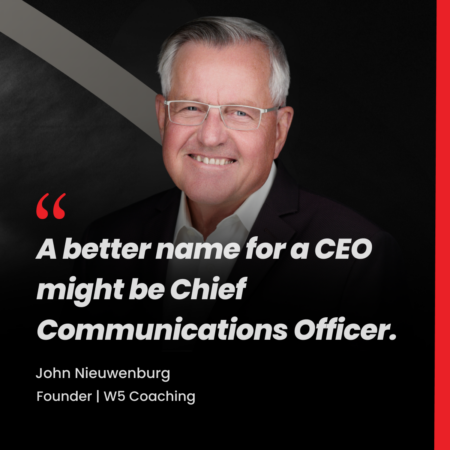
A better name for the CEO’s job would be Chief Communications Officer

How much of your job do you think communication is?
Before I became a coach I was President and CEO of BC Liquor Stores, a multi-billion-dollar operation with several hundred locations.
The lesson I took from that job, more than any other, was that most of the work was communication.
A better name for the role would be Chief Communications Officer.
Your job is to get everybody on the same page. That’s the bulk of it.
And people don’t get on the same page because you decided something. They get there because they feel like they’re contributing to something that matters to them.
You’re the one who creates that feeling. Nobody else in the business can do it for you.
A monthly town hall makes the listening visible to the whole company
Here’s what my client is putting in place, starting this month.
Once a month, the whole company gets together. It doesn’t need to be long. The agenda is the same every time.
There’s a whiteboard at the front of the room. That whiteboard never gets erased. It gets updated once a month.
On it are the three things the company raised last month that he said he’d work on.
He opens by reporting on those three. One we’re doing, and here’s what that looks like. Two we can’t, and here’s why.
Then he moves on to what’s come in since. Five more suggestions this month, and here’s what happens to each of them next.
That’s the whole meeting.
Nobody expects you to say yes to everything
That’s what the “we can’t, and here’s why” column is for.
What people want to know is that their idea got addressed. Approval is a separate question.
It’s how scattered suggestions turn into a two-way discussion.
When my client saw it laid out this way, his reaction was that it was obvious. Of course that’s what you do. That’s what it means to be a leader.
The 500th time you explain the business, it still signals something
The same thing is true well outside the town hall.
How many times have you given the same onboarding talk?
You’ve walked a new hire through the business so many times you could do it in your sleep. Thirty minutes, same story over and over again.
It’s tempting to hand that off, or to trim it down to fifteen minutes.
Don’t. The 500th time you tell someone what this business is for, it still signals something. It signals that it mattered enough for the owner to be the one who said it.
Communicate, communicate, communicate. That’s the job.
You can’t see the whole picture when you’re stuck inside the frame
This owner was doing almost everything right.
He listened. He acted on good ideas. His people weren’t shy about bringing him things.
One piece was missing. It wasn’t visible from where he was sitting, and that’s usually how it goes.
My part in this was two things. I asked him what his people were actually seeing.
Then I put a structure in front of him that has proven successful with other owners. He took it from there.
A town hall and a whiteboard. That’s the change. His company is about to go from wondering whether their input matters to watching it get processed in front of them, every month.
Most owners I work with are already doing more right than they think. What’s missing is usually the part they have no way of seeing on their own.
Want some outside perspective into your business? Book a 15-minute call with me.
More on communication, alignment, and making sure your team hears what you decide
Lessons from a CEO: Five Insights for Small Business Owners
My five takeaways from running BC Liquor Stores, including what happened when I inherited 150 simultaneous priorities.
The Hidden Math of Complexity
Why the informal communication that worked at three people falls apart at ten.
Your Team Can’t Follow You If They Don’t Know Where You’re Going
Ask your foreman, your office manager and your newest hire what the business is trying to accomplish. Three different answers means the picture in your head never made it out of there.
Want Better Performance? Tell People Where They Stand.
Most of your team is guessing about whether you think they’re doing well, and people who guess tend to assume the worst.
Want Better Employees? Start with Better Onboarding
What a new hire reads into their first day, and why you are always communicating something whether you mean to or not.
How to get every team member rowing in the SAME direction
The full meeting rhythm a town hall sits inside. Annual, quarterly, monthly, weekly and daily, what each one is for, and which single meeting to run if you only run one.

Build a Self-Managing Company
How to build a business that runs smoothly, profitably, and (mostly) without you.
Feeling stressed out and overwhelmed with a business that is taking all your time - and not giving you enough in return?
Are you finding it challenging to hire the right team (and get them to do the right things)?
I wrote this little guide for you!
Enter your details below to receive your free copy!