
How to be less involved in your business (without everything falling apart)


John Nieuwenburg
John Nieuwenburg has been a professional business coach since 2004. Prior to becoming a coach, he held executive positions with Tip Top Tailors and BC Liquor Stores. In 2019, MacKay CEO Forums awarded him with Canada’s CEO Trusted Advisor Award in the Small Business category. Since becoming a coach, John has worked with over 400 clients, taking them through a systematic process that helps them feel organized, confident and in control of their businesses.
If You Step Away, Does It All Fall Apart?
Nothing gets quoted, ordered, approved, or answered until you weigh in on it.
Your phone rings, pings, and dings all day. Your team is capable, but they still check with you for everything.
So you tell yourself what almost every owner in your position tells themselves.
I need to be involved.
And you’re right, in one narrow sense. If you stopped being involved tomorrow, things would go sideways by Thursday.
When the owner needs to be involved in everything, they end up as the hub in a wheel
Picture a bicycle wheel.
Spokes running in from the rim, and you sitting at the centre as the hub. Every question, every decision, every piece of direction travels along one of those spokes to you, and then back out again.
That’s the shape of a business where the owner has to be involved. We call it hub and spoke, and once you see it you can’t unsee it.
Now imagine that for a while you’re not available. Take the hub out of the wheel.
What happens to the business?
It collapses.
If the business needs you in the middle of it to keep functioning, you don’t own a business yet. You have a job in a business with your name on it.
I want to take some of the sting out of that idea, because owners hear it and assume it means they’ve done something wrong.
They haven’t.
Being a “hub and spoke” manager is a normal stage of the Owner Evolution
After coaching more than 400 owners, I’ve come to see five levels an owner moves through: solopreneur, technician, operator, leader, and investor.
Being the hub is the operator level. It’s what happens when a business gets big enough that you can no longer do all the work yourself, so you hand off the doing while keeping every decision.
It’s a normal stage. Nearly everyone passes through it.
The trouble is that it’s also the easiest stage to get stuck in, because the obvious fixes all keep the hub exactly where it is. You get faster at answering. You clear the backlog on Sunday. You put a better system in place for people to reach you.
None of that changes the wheel. It just oils it.
The key to getting out of the hub and spoke is to shift from being involved to being able to see
Owners often start to feel anxious when they first consider the idea of being less involved.
Ask them what’s driving the anxiety and the first answer is usually that there’s too much coming at them.
Stay with the question a little longer and something else tends to surface.
You don’t actually know what’s going on in your business right now. Not with enough confidence to say whether it’s working at the level you need it to.
So you stay involved, because involvement is the only way you currently have of knowing.
The anxiety you’re feeling is telling you something quite specific. You can’t see well enough to step back.
That’s the shift that has to happen. From “I need to be involved” to “I need to be able to see.”
What would have to be true to make it possible for you to leave for a month?
Here’s the question I put to owners who are sitting where you are.
Imagine you go away for a month. During that month, you get one hour a week with one person in your business. One conversation, sixty minutes, and nothing else.
What would have to be true so that you came out of that hour knowing what’s working, what isn’t, what the problems are, and what your team recommends doing about them?
Most owners can’t answer that on the spot, and that’s fine. It’s not a quiz.
But notice what the question is doing.
The question is asking what you would need to be able to see, so that one hour a week would be enough.
Three things to install that give you visibility into your business
None of these are complicated.
What they have in common is that they move information out of your head and your inbox, and into a place where you can look at it on purpose instead of absorbing it by being present all day.
1. Numbers you can read at a glance
When you were smaller you could hold the whole business in your head. You knew every job and every dollar, and you could feel whether things were on track.
At some point the business gets too big for your gut.
Key Performance Indicators are how you get that back. They’re the small set of measures that tell you whether each part of the business is delivering.
Keep it tight. No more than about three numbers per area, and a report that fits on one page. Owners who try to track everything end up reading nothing.
Include leading indicators, not only results. Revenue tells you what already happened. Leads generated tells you what’s coming. One is a rearview mirror, the other is a windshield, and you need both.
Then put them somewhere you can see them together. A simple spreadsheet is plenty to start. Green means don’t think about it. Yellow means someone needs guidance or resources. Red means something has to change now.
2. A formal rhythm for checking in
Most owners have no shortage of contact with their team. What they don’t have is contact that happens on a schedule, with a set agenda.
That’s the difference between being interrupted and being informed.
Build a meeting rhythm: daily, weekly, monthly. The daily huddle takes fifteen minutes. Everyone who owns an area of the business shows up ready to answer three questions.
- What’s up? What matters to you today, so we can compare it against what I’m expecting and close the gap before you leave the room.
- Where are you stuck? Parts are short, someone’s off sick, a customer is unhappy.
- By what measure do we know we’re delivering?
For this to work, every important area of the business needs a named person who owns it. Finance, operations, sales, delivery, customer service. Not a committee, and not you by default.
When your staff have a question, they should be phoning the person whose job it is to know.
If you can’t name that person for a given area, you’ve just found one of the reasons everything still comes back to you.
3. Standards that live somewhere other than your head
People ask you because you’re the only place the standard exists.
Write it down instead. SOPs, checklists, position descriptions, an agreed way of doing the work.
A position description should tell someone what they’re expected to do, what results they’re on the hook for, and how they’ll know they’re doing well without having to ask you.
Aim for about 85% of the work in someone’s area being routine and systematized. The other 15% is the exceptions, where you genuinely do want to be involved. Systematize the routine and humanize the exceptions.
Then tell your team which is which, so they know when to handle it and when to bring it to you.
Standards do something else too. They let you give feedback in small doses, as things happen, instead of saving it up for a review six months later.
A team that always knows where it stands can correct itself without you in the room.
When you have visibility into your business, an hour a week is enough to know where you stand
Put those three in place and something changes in how that month away would go.
You’d open one report and know where things stand. You’d spend your hour on the two items that are red, not on catching up on the eighty that were fine all along.
The quiet takes some getting used to. I’ve had clients tell me the silence made them nervous before it made them comfortable.
But a quiet phone is confirmation. You can finally see the business clearly enough to stop standing in the middle of it.
So ask yourself the question again. If you had one hour a week, what would have to be true?
If you’d like help building the answer, book a 15-minute call with me and we’ll talk about what visibility would need to look like in your business.
Our proven business coaching program has delivered results to over 400 clients
Business coaching can help you:
- Improve operations, implement systems and remove bottlenecks so that you get your time back
- Hire and train the right team and eliminate people problems
- Grow your business with bigger and better clients
- Overcome cash flow issues and improve your financial management
- Make better decisions and become more profitable
When your business runs well, you get your life back.
Services are confidential.
Click here for full details or click the red button to schedule a complimentary 15-minute call.

Coaching only works when there's a good fit between coach and client. If you'd like to explore coaching, book a confidential 15-minute call so we can get to know each other.
More on getting out of the hub and spoke, and seeing what’s going on without sitting in the middle of it
Take Back Your Time
The bicycle wheel on video, plus the 1-3-1 Rule for getting your team to bring you a recommendation instead of a question.
Do You Have a Job? Or do You Own a Business?
Walks through all five levels of the Owner Evolution in detail, including what the operator stage looks like day to day and the mindset that keeps owners sitting in it.
Stuck in the Middle of Everything? It’s Time to Become a Leader Owner.
A video and transcript on why the operator to leader step is the hardest one in the whole progression, including the story of a factory owner who was in his car by 4:30 every morning for ten years.
How to Delegate Decision Making (Not Just Tasks)
Sorts decisions into hats, haircuts, and tattoos, so you can tell which calls your team can already make and which ones genuinely need you.
4 Ways Business Owners Sometimes Feel They Are Losing Control (And How to Regain It)
Four specific places the feeling of losing your grip tends to come from, including the crossroads owners reach where the tempting move is to shrink the business back to the size they could hold in their head.
Are you tracking the numbers that matter?
Goes deeper on choosing KPIs. Leading indicators versus lagging ones, how few numbers to actually track, and what went wrong at Wells Fargo when the targets weren’t balanced.
How Do You Get the Right People Doing the Right Things Right?
The three pillars of team management, including the full meeting rhythm, position descriptions, and the traffic light dashboard. Ends with a client who caught herself realizing she could leave at two in the afternoon to go to yoga.
The Self-Managing Business: a Checklist for Growth and Freedom
Lays out the four things that have to be true for every area of your business before it can run without a bottleneck, plus a sample structure for an HVAC company.
The Magic of Systems
Goes deeper on systematizing the routine and humanizing the exceptions, including how to get your staff to write the SOPs instead of writing them yourself.
Want Better Performance? Tell People Where They Stand.
Why the annual review lands too late to help anyone, and what changes when people hear where they stand in small doses instead.
Staying Accessible Without Losing Control
A practical way to contain the rings, pings, and dings without becoming unavailable to your team or your customers.
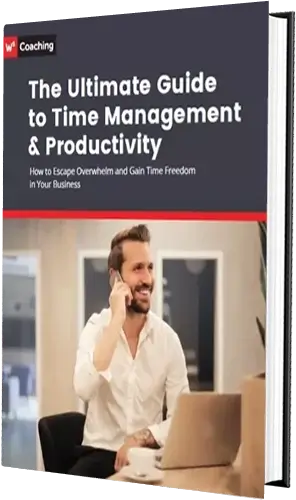
Get Your Time Back
How to escape overwhelm and gain time freedom in your business

Get control of your email and calendar
-
Prioritize your most important tasks
-
Become more productive than you ever thought possible

Ready to free up 5-7 hours per week? Download this guide today! Enter your details below to receive your free copy!