
How Systems Get You Out of the Middle of Your Business

John Nieuwenburg
John Nieuwenburg has been a professional business coach since 2004. Prior to becoming a coach, he held executive positions with Tip Top Tailors and BC Liquor Stores. In 2019, MacKay CEO Forums awarded him with Canada’s CEO Trusted Advisor Award in the Small Business category. Since becoming a coach, John has worked with over 400 clients, taking them through a systematic process that helps them feel organized, confident and in control of their businesses.
Your Business Should Run on Systems, Not on You
Your team is capable. Yet every decision, question and approval still finds its way back to you.
You’ve become the hub of the business, and the business can only move as fast as you can.
Most owners try to fix this by working longer hours or looking for better people.
What actually gets you out of the middle is structural trust: systems your team can follow and you can rely on, whether or not you’re in the room.
In this video, I talk about:
- The difference between delegating to a pair of hands and delegating to a set of brains
- What McDonald’s fries and a 1930s Boeing crash each teach us about systems
- Why “every job I do is custom” doesn’t mean you can’t develop systems and processes
- What has to be in place before you can trust the system instead of checking everything yourself
- How systems, people and leadership fit together once you’re out of the middle
Watch the video below, or scroll down to read the details.
When everything runs through you, the business can only grow to your personal limits
Most owners get their business to a certain size on the strength of relationships. You know everyone. You see the work. You trust your people because you’re talking to them all day.
Somewhere between a handful of people and a dozen, that stops working. You can’t be in every conversation anymore, so the conversations come to you instead.
I call this hub and spoke. You sit at the centre of the wheel, and every question, decision and approval travels along a spoke to you and back out again.
It feels like being responsible. In practice, nothing moves until you’ve weighed in, and the business can only go as far as you can personally stretch.
Getting out of the hub takes a different kind of trust, one that doesn’t depend on you watching.
 Structural trust means trusting the system you and your team have agreed on
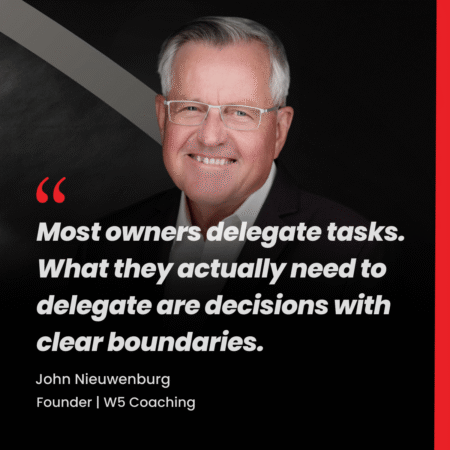 Structural trust means trusting the system you and your team have agreed on
Relational trust is the kind we all know. Do I believe this person will do the right thing?
Structural trust works differently. Together, you design a system and agree on the outcome it should produce. If the person follows the system, they’re going to get that outcome.
That changes how you think about delegation. Most owners think of it as handing out tasks to a pair of hands. As the business grows, you need to start delegating to a set of brains: capable people who own an outcome, working inside a process you both trust.
Systems are how McDonald’s gets teenagers to make perfect fries every time
Have you ever wondered how McDonald’s gets its fries to taste the same in your town and mine?
They’re made by 16-year-olds. The same 16-year-olds whose parents can’t get them to clean their bedrooms.
McDonald’s has a great system, great recipes and clear SOPs. The fries come out right no matter who’s working the fryer.
For that kind of work, a recipe is enough. The job is to reproduce the same fries over and over.
But would the same approach work for getting an airplane off the ground, or running an operation in a hospital?
A pilot and a surgeon are both highly trained. They’re also both human, and humans make mistakes.
Even the most experienced pilot needs a pre-flight checklist
In the 1930s, Boeing built the most sophisticated airplane of its day. The most experienced pilot in the army took it up, and it crashed.
When they investigated, they found he had simply forgotten one step.
The conclusion at the time was that planes like this were too complicated for people to fly. Someone at Boeing had a better idea. They would trust the pilot’s training, and give him a structured process to follow. That was the beginning of the pre-flight checklist.
So let me ask you. Would you get on a plane if you knew the pilot had skipped the checklist?
Of course not. Yet most businesses run without their own version of one. There’s no agreed description of the process and the outcome that both the person doing the work and the owner expecting it can point to.
That’s the gap structural trust fills. You trust the training, and you trust the process.
The best systems are simple. You don’t need a thick binder of procedures to get started. A checklist, written down and actually used, can make a massive difference.
Your work can be custom and your process can still be the same every time
I once gave a presentation to a group of custom cabinetmakers, and one of them pushed back.
“I don’t make French fries,” he said. “I build kitchen cabinets. Every job is custom. None of it is reproducible.”
He was right that every job is different. Every kitchen is its own design.
What has to stay the same is the process you use to build it. A reproducible process is what lets you deliver a different custom kitchen every time, at the same standard.
If the process changes with every job, you can never do it again. And if nobody else can repeat it, it has to keep running through you.
Systematize the routine and humanize the exceptions

So where do you start? With a guideline I come back to with almost every client.
About 85% of what happens in your business is routine. It’s work that is (or should be) done the same way every time. That’s the work to document in SOPs.
This can sound like a big project, but it isn’t yours to take on. Get the people doing the work to write the procedures. They know the steps better than you do, and writing them down shows they understand what good looks like.
The other 10% to 15% will be exceptions. That’s where you step in.
When an exception comes up, deal with it. Then ask:
“How would the system need to change so that this exception doesn’t happen again?”
Every time you ask that question, the system gets a little better and the exceptions get a little rarer.
Structural trust depends on a few things being in place
A checklist on its own won’t get you out of the hub. Structural trust exists when:
- People know what to do and how to do it
- People know what good looks like, and what 100% complete means
- People know their boundaries: what they’re authorized to decide, and what they need to check with you on
- You can see how the work is going without having to watch the person doing it
- There’s a way to surface problems early
- Accountability is predictable
- The business still functions when key people are away
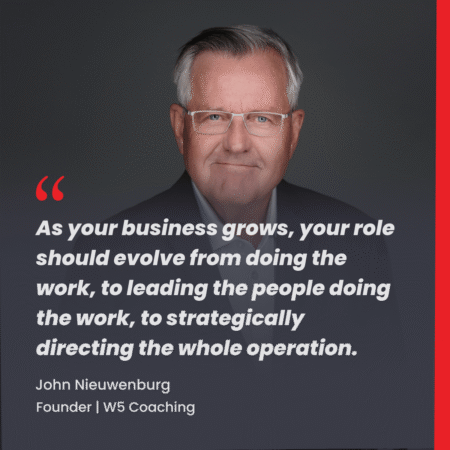
Systems run the business, people run the systems, and you lead the people
When people run the business, the business rises and falls on the quality of whoever happens to be there. And people come and go.
When systems run the business, the structure becomes the backbone. People apply the systems. They can be trained against a clear standard, so you can hire for character and fit instead of hunting for someone who already knows your way of doing things.
And your job changes. Instead of answering every question, you lead: setting direction, giving feedback, and holding people accountable.
Want help building systems your business can run on?
Building simple systems that let the business run without you in the middle is a big part of the work I do with clients.
The first step is a 15-minute Fast Track Call. There’s no fee and no sales pressure.
Our proven business coaching program has delivered results to over 400 clients
Business coaching can help you:
- Improve operations, implement systems and remove bottlenecks so that you get your time back
- Hire and train the right team and eliminate people problems
- Grow your business with bigger and better clients
- Overcome cash flow issues and improve your financial management
- Make better decisions and become more profitable
When your business runs well, you get your life back.
Services are confidential.
Click here for full details or click the red button to schedule a complimentary 15-minute call.
Coaching only works when there's a good fit between coach and client. If you'd like to explore coaching, book a confidential 15-minute call so we can get to know each other.
More on structural trust, building systems, and getting out of the hub
Why Can’t I Trust My People to Do the Job Right? (It’s Not What You Think)
My full walkthrough of relational vs. structural trust, including why trust gets harder as a team grows and four mindset shifts that help you let go.
The Hidden Math of Complexity
Why a business gets harder to run as the team grows.
Can You Take Two Weeks Off Without Checking Your Phone?
A video of my SCALE presentation, covering the five things a business needs to grow beyond the owner, and what time freedom looks like once they’re in place.
How to be less involved in your business (without everything falling apart)
What it takes to move from being involved in everything to being able to see what’s going on, so the business keeps running when you step back.
9 Warning Signs You’re a Hub-and-Spoke Owner
Nine signs the business leans too heavily on you, from signing every cheque to being copied on every email, and what to do about each one.
Using Checklists and SOPs to Develop Systems for Your Business
When to use a checklist and when to use an SOP, and how each one helps your team run the work without you.
How Showing Your Process Makes it Easier for Clients to Buy
Why custom work needs a defined process even more than routine work does, with a construction company’s six-step client process as the example.
The Owner’s Real Job: Build a Business That Runs Without You
My conversation with Darren Mitchell on the Exceptional Sales Leader Podcast about why owners get stuck when they never change roles, and how systems, people and leadership fit together once they do.
How to Delegate More Effectively
Three levels of delegation, from handing off tasks to handing off authority and autonomy, and how to decide what to let go of.
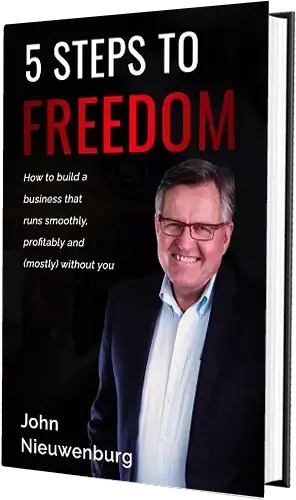
Build a Self-Managing Company
How to build a business that runs smoothly, profitably, and (mostly) without you.
Feeling stressed out and overwhelmed with a business that is taking all your time - and not giving you enough in return?
Are you finding it challenging to hire the right team (and get them to do the right things)?
I wrote this little guide for you!
Enter your details below to receive your free copy!