
The High Cost of a Fragmented Calendar


John Nieuwenburg
John Nieuwenburg has been a professional business coach since 2004. Prior to becoming a coach, he held executive positions with Tip Top Tailors and BC Liquor Stores. In 2019, MacKay CEO Forums awarded him with Canada’s CEO Trusted Advisor Award in the Small Business category. Since becoming a coach, John has worked with over 400 clients, taking them through a systematic process that helps them feel organized, confident and in control of their businesses.
Why Does Your Day Feel So Fragmented?
A client came to me a while ago feeling upset. He said his mind felt jagged, like his whole day had broken into pieces as he bounced from one thing to the next.
I asked him to show me his calendar.
It looked exactly the way his head felt. It went back and forth from one kind of work to another, all day long.
What helped him make sense of it is in the short video below, or you can scroll down to read.
Many owners end their day feeling scattered
I hear some version of this from a lot of the owners I work with.
As the business grows, more of your day goes to switching. You have a conversation with a team member about a client issue, then a decision about pricing, then a look at the numbers, then a question about next week’s schedule.
Your phone rings, pings and dings in between.
None of those things is especially hard on its own.
Yet by the end of the day you feel drained, and it’s hard to say what you moved forward.
So why does a day like that wear you out so much?
Your brain can only do one thing at a time 

There’s a simple exercise that shows what’s going on.
First, recite the alphabet from A to Z as quickly as you can. Most people do it in about eight seconds.
Next, count from 1 to 26 as fast as you can. That usually takes about the same time.
Now alternate between the two: A1, B2, C3, D4, E5, F6, G7. Very few people get much past G before they slow down or lose track.
Each list on its own is easy. What trips you up is going back and forth between letters and numbers, because your brain has to change gears every time.
Most people believe they’re good at multitasking, but nobody is. Your computer might have 16 processors. Your brain has one, and it can only do one thing at a time.
So what feels like multitasking is switch tasking. Every time you move from one task to another, your brain pays a cost to change context.
Move through five or six different contexts in a morning and that cost adds up, which is why a day full of switching leaves you feeling the way my client did.
Bundling similar work cuts down on the switching
If the cost comes from switching, the answer is to switch less, rather than to push harder through the same kind of day.
That’s where bundling comes in.
Instead of scattering similar tasks across the day, you collect them and do them all at one go.
Here are three ways to put bundling to work in your week.
1. Set aside blocks of your week for similar work
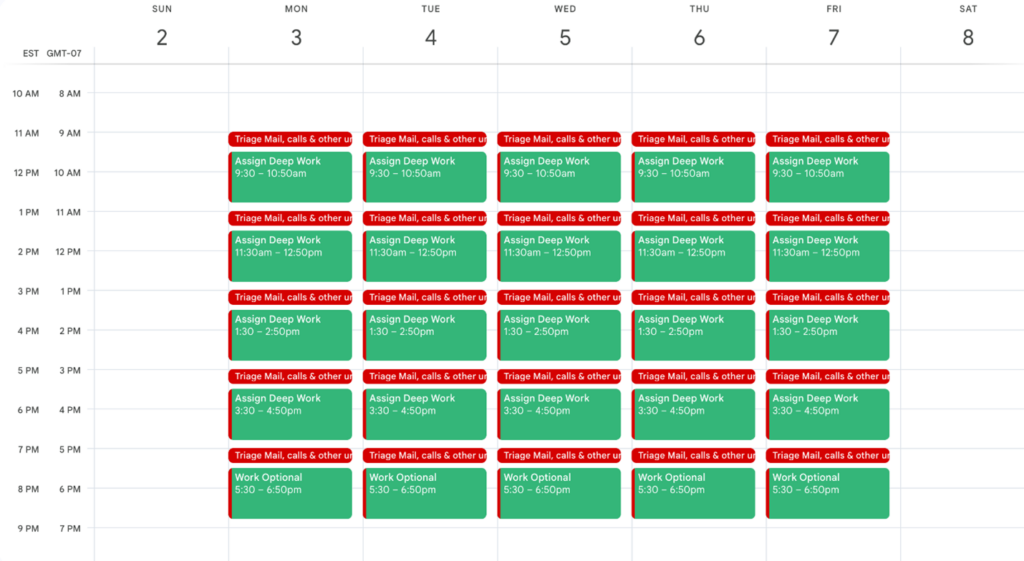
I have clients set up what I call a default diary, a standard week with time blocked out in advance for their most important work.
It works best when each block holds one kind of work.
Conversations with your team sit together, reviewing the numbers sits together, and planning gets its own time instead of being squeezed between calls.
2. Deal with messages and questions at set times

Messages and quick questions are some of the biggest sources of switching in an owner’s day, because they arrive whenever someone else decides to send them.
Rather than answering each one as it comes in, set a few times in the day to go through them together.
This is the difference between being available and being accessible. When you’re available, you’re available on other people’s terms. Anyone can call, ping or stop by whenever they need you, and each time, you’re pulled away from whatever you were doing.
When you’re accessible, your people can still reach you, on your terms. Your team knows when they’ll hear from you, and the hours in between are yours.
3. Keep your thinking work in long, uninterrupted stretches
Some of your work needs more than a few minutes of attention at a time.
Planning, working through a difficult problem and making a decision that will shape the business for years all suffer when they’re broken up.
Give that work a long stretch with nothing else scheduled around it, and protect it the way you would a meeting with an important client.
A clearer day starts with how your calendar is set up

Once my client understood why he felt so fragmented, the next step was clear to him.
He needed to line up his calendar so it focused on one topic at a time, instead of bouncing between five, six, seven or eight things in the same day.
If you opened your calendar for this week, how often would it ask you to switch?
Protecting time to think is also where coaching starts. A weekly coaching session puts an hour on your calendar that’s set aside for working on your business instead of in it.
Once that hour is in place, the first thing we usually work on together is taking control of the rest of your calendar, so you can free up more time.
If you’d like that kind of hour in your week, book a call and we’ll talk about what it could look like.
Our proven business coaching program has delivered results to over 400 clients
Business coaching can help you:
- Improve operations, implement systems and remove bottlenecks so that you get your time back
- Hire and train the right team and eliminate people problems
- Grow your business with bigger and better clients
- Overcome cash flow issues and improve your financial management
- Make better decisions and become more profitable
When your business runs well, you get your life back.
Services are confidential.
Click here for full details or click the red button to schedule a complimentary 15-minute call.

Coaching only works when there's a good fit between coach and client. If you'd like to explore coaching, book a confidential 15-minute call so we can get to know each other.
More on taking control of your calendar, protecting your focus and working on your business
How to Take Back Your Time and Improve Your Productivity
The three steps I take new clients through to free up five to seven hours a week: a time audit, a default diary, and two short planning habits.
Feel like you don’t have enough time? Free up 5-7 hours every week by doing this.
How a one-week time audit and a skill/fun box help you find the five to seven hours of work you shouldn’t be doing, and why your calendar shows what your true priorities are.
Find More Time in Your Day by Conducting a Simple Time Audit
How to track a typical week in 15-minute blocks and use what you find to build a default diary, plus what a client who didn’t want to do the exercise said about it afterwards.
Staying Accessible Without Losing Control
How to handle interruptions in set windows during the day, protect time for focused thinking, and explain the new rhythm to your team so they know how to reach you.
Take Back Your Time
My video on why being the busiest person in your company is a leadership problem. It covers the difference between being available and being accessible, and how a few check-in windows a day leave you several 90-minute blocks of your own.
Why You Need to Shift from Working IN Your Business to Working ON Your Business
The story of an accounting client who forgot it was month end because he no longer needed to be involved, and the shifts that take you from running everything to working on the business.
Why Your Business Isn’t Growing
My conversation on the Small Business Pivots podcast about the five to seven hours of work most owners do every week that they shouldn’t be doing, starting with the rings, pings and dings.
How to Make Progress on What Really Matters
Three questions for cutting a long to-do list down to the work that matters most, including the one thing in your business no one else can do as well as you.

Get Your Time Back
How to escape overwhelm and gain time freedom in your business

Get control of your email and calendar
-
Prioritize your most important tasks
-
Become more productive than you ever thought possible

Ready to free up 5-7 hours per week? Download this guide today! Enter your details below to receive your free copy!