
The Self-Managing Business: a Checklist for Growth and Freedom

You’ve Built Something Real. Now What?
You have a team.
You have revenue.
You’re proud of the business you’ve built.
But something still feels off.
Maybe you’re still the one everyone comes to when a decision needs to be made.
Maybe growth has plateaued.
Maybe you work more hours than you should for someone who technically “has people.”
If that sounds familiar, you’re ready for the next step.
It’s time to make your business self-managing.
What a Self-Managing Business Looks Like
A self-managing business isn’t one that runs without a leader.
It’s one that runs without a bottleneck.
Here’s the simplest way I know to describe it:
Someone is responsible for every important aspect of your business. That person knows what they’re accountable for. They know how you’ll measure success. And some part of their compensation is tied to how well they deliver.
That’s it. Four elements.
Here’s what that looks like in practice.
Say you’re an HVAC company.
You need a service manager, a commercial projects manager, and a residential projects manager — three different names, three distinct areas of responsibility.
You need someone in charge of finance. Someone in charge of HR. A sales leader. And a general manager who oversees day-to-day operations and keeps everyone on point.
When that structure is in place, everybody knows who does what.
And more importantly, everything no longer needs to flow through you.
Why “Having a Team” Isn’t Enough
The owners I work with at this stage have already made some key hires.
They’ve moved past the solo owner phase.
But they often get stuck at what I call the operator level — where they’re still directing the details rather than leading the outcomes.
The shift you need to make is from manager to executive leader.
A manager assigns tasks and checks the work.
An executive leader assigns areas of responsibility and holds people accountable for results.
That’s a fundamentally different relationship with your team.
And it requires a fundamentally different version of you.
I use a Navy metaphor to explain this.
Let’s say you’re the captain of a 50-foot boat with a crew of 10. You’re also the most capable engineer on board. So what happens? You’re in the engine room with tools in your hands — and trying to captain the ship.
Now upgrade to a 150-foot boat with a crew of 50. How often should that captain be in the engine room turning wrenches? Maybe in a true emergency. But there should now be a chief engineer.
Upgrade again to an aircraft carrier with 2,000 people. That captain might go to the engine room once — to hand out a 20-year service award. That’s about it. There’s someone who manages the person who manages the engine room.
Same person. Same title of “captain.” Completely different job.
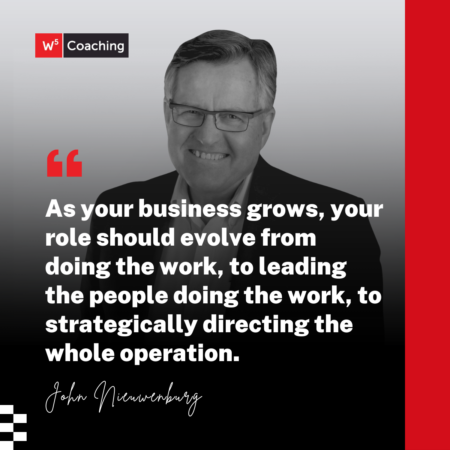
Your business should work the same way. As it grows, your role should evolve from doing the work, to leading the people doing the work, to strategically directing the whole operation.
That’s the shift.
And it won’t happen by accident.
Four Things That Make a Business Self-Managing
1. Clarity of Responsibility
Every important area of your business needs a named person who owns it.
Not someone who helps with it. Not a committee. One person, with their name on the door.
Finance. Operations. Sales. HR. Customer service.
Whatever is critical to how your business functions — someone is responsible for it.
When there’s no clear owner, things fall through the cracks. Or worse, they all flow back to you.
2. Clear Accountabilities
Responsibility without accountability is just a title.
Each of your leaders needs to know what they’re being held accountable for — specifically, in terms of outputs and results.
Not just activities. Not just effort. Outcomes.
This is the conversation most owners avoid.
But having it is what separates a team that performs from a team that merely shows up.
3. A Measurement System
Here’s a practical reality: your business probably has dozens of things worth tracking. You can’t stare at all of them all the time.
Adopt a simple system: green, yellow, red.
If things are green, don’t think about them.
Focus on the few that are yellow: those leaders need attention or resources to get back on track.
And pay close attention to the ones that are red. Those might require a different conversation entirely.
The point of a reporting system isn’t to micromanage.
It’s the opposite.
When you can see at a glance what’s on track, you can stop hovering over everything and start trusting your team to manage their own areas.
4. Compensation Tied to Performance
People pay attention to what they’re paid to pay attention to.
If your compensation structure doesn’t reflect performance, you’re asking your team to care about outcomes that have no consequence for them personally.
This doesn’t have to be complicated.
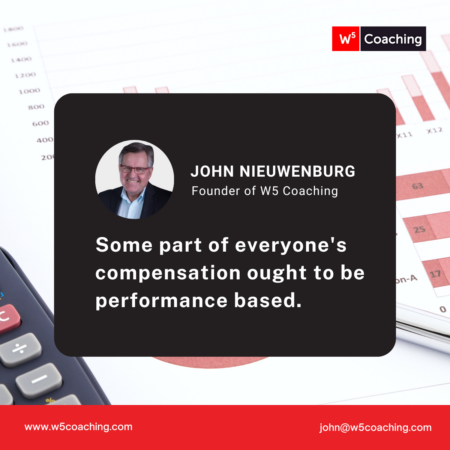
But some portion of how your leaders are compensated should be connected to how well they deliver on their accountabilities.
The Owner’s Role in All of This

A self-managing business doesn’t happen to you.
You design it.
You set the structure.
You have the accountability conversations.
You build the dashboard.
You connect compensation to performance.
And then you let people do their jobs.
That last part is harder than it sounds.
Most owners have been the problem-solver, the decision-maker, the go-to person for so long that it’s become part of their identity.
The shift is this: stop asking “how can I get this done?” and start asking “how can this get done?”
Those questions lead to completely different answers.
The first one keeps you in the middle of everything.
The second one forces you to build the structure, the team, and the systems that make you optional in the day-to-day.
That’s what it means to work on the business instead of in it.
When all four elements are in place — clear responsibility, clear accountability, a measurement system, and performance-based compensation — everything changes.
Your team stops coming to you for every little thing, because they know what they’re supposed to do and what success looks like.
You stop being the bottleneck that keeps growth capped at whatever you personally can manage.
And you get the thing most successful owners at your stage actually want: not just a bigger business, but a better-run one.
One where you can focus on strategy, growth, and the future — instead of firefighting the present.
That’s when you become the aircraft carrier captain.
You’re not in the engine room anymore.
You’ve got someone who manages the person who manages the engine room.
And from the bridge, you can finally see where you’re going.
Ready to build the structure that gets you there? Book a free 15-minute call with John.

Build a Self-Managing Company
How to build a business that runs smoothly, profitably, and (mostly) without you.
Feeling stressed out and overwhelmed with a business that is taking all your time - and not giving you enough in return?
Are you finding it challenging to hire the right team (and get them to do the right things)?
I wrote this little guide for you!
Enter your details below to receive your free copy!