
Why Your Business Isn’t Growing

John Nieuwenburg
John Nieuwenburg has been a professional business coach since 2004. Prior to becoming a coach, he held executive positions with Tip Top Tailors and BC Liquor Stores. In 2019, MacKay CEO Forums awarded him with Canada’s CEO Trusted Advisor Award in the Small Business category. Since becoming a coach, John has worked with over 400 clients, taking them through a systematic process that helps them feel organized, confident and in control of their businesses.
Why Your Business Isn’t Growing
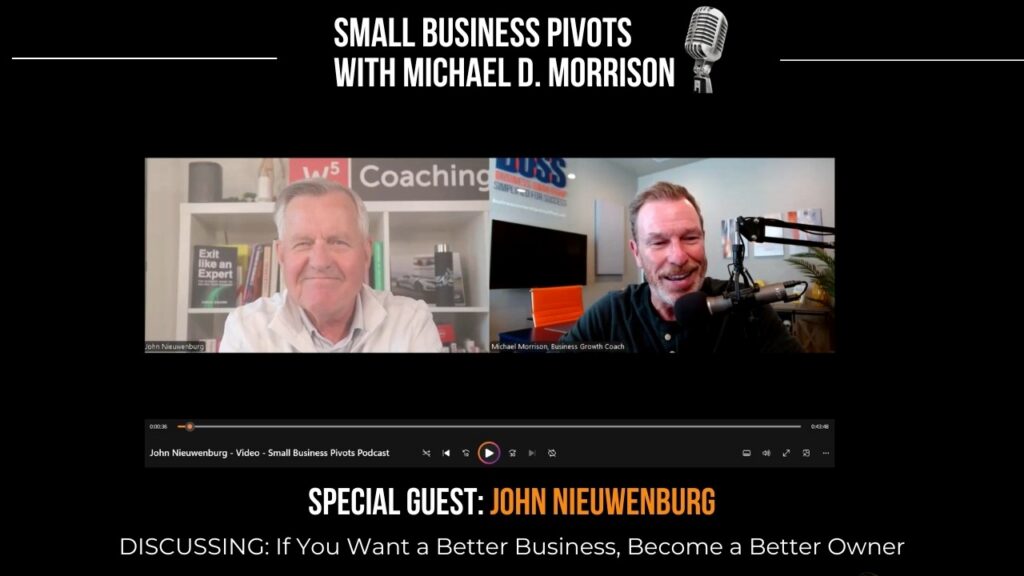
I recently sat down with Michael Morrison on the Small Business Pivots podcast for a wide-ranging conversation about what it actually takes to grow a small business (and why the answer usually isn’t what owners expect.)
Here’s some of what we got into:
- The yo-yo trap almost every owner falls into: You can afford to hire, then you can’t, then you need more sales, but to get more sales you have to do the work yourself – and how to break the cycle
- What to do when your team follows the system perfectly… at exactly the wrong time
- Why most business owners are doing 5–7 hours of work each week they shouldn’t be doing (and the simple question that reveals exactly which tasks those are)
- The real reason your business feels stuck even though you’re working harder than ever (hint: it has nothing to do with your team)
- The one word you can remove from a question that changes how you think about your entire business
- Why the Stanley Cup is a better hiring model than a job description
- The financial question your accountant probably can’t answer. Not because they’re bad at their job, but because you’re asking the wrong person
- How a business owner with 20 plus employees ended up back at work at 4 a.m. for three months and what that tells you about the hole in most “successful” businesses
You can listen to the full episode or read the transcript below:
John Nieuwenburg recently joined Michael D. Morrison on the Small Business Pivots podcast to talk about why growing a business always starts with growing the owner. Below is an edited transcript of their conversation.
Michael: Welcome to another Small Business Pivots, where we bring guests from around the world. Today you might want to buckle up because we’ve got two business coaches on the show, and I know you’re going to learn a lot. John, I’m going to let you introduce yourself — I know a lot of our listeners like to hear a little bit of background, how you got into the adulting world and a bit about your history. So I’ll let you have the floor.
John: Well, thanks for that. Pleasure to be here. I’m a business coach and I’ve been a business coach since 2004. When I first started, I had a bit of an epiphany, and the epiphany was, “Oh my gosh, I’ve always been a business coach.” It was Steve Jobs who said, “You can only connect the dots going backwards.” And my epiphany was connecting some dots. I’ll share a few of them with you.
I’m the eldest of eight children. So you can imagine the role you’re cast into if you’re the eldest of eight. I’m hardwired to be a teacher and I knew that in high school, but in those days that meant wearing a Harris Tweed coat with elbow patches, and that bureaucratic style of teaching didn’t appeal to me very much.
One of the most important things I learned — early in the 80s, I learned something called the Socratic method of leadership. Socrates had it: the best way to help somebody is to help them figure it out for themselves. And I’ve been practicing that style of leadership ever since. At its core, that’s really what coaching is. So I’ve been thinking and acting like a coach since that time.
Before that, I was the president of a very large beverage alcohol retailer — three billion in sales, 200 locations, and 4,000 full-time equivalents. And I started business life at a national Canadian men’s wear retailer. I was a sales guy on a sales floor and 17 years later, after living in a bunch of places, I was in head office in Toronto. After five years I decided I really wanted to get back to the west coast and Vancouver and all of what that has to offer. So I got myself headhunted and that’s how I came back to Vancouver.
A couple more bits. My wife Jennifer and I have been together for about 20 years. We don’t have any kids, but like so many others, we got a dog in April of 2020 — you might remember we were looking for reasons to get outside during COVID. I used to be a pretty avid skier, have some gray hair, my knees don’t work as well, but I do go golfing twice a week. And the last thing I’ll say is I’ve read 500 books, which may seem like a lot, but if you read 10 books a year for 50 years, you get to 500. I actually think the number is conservative because at one stage of life, I threw out a thousand paperbacks. So I’m very confident 500 is a real number. Anyway, that’s by way of a bit of background.
Michael: That’s fantastic. Well, as business coaches, I often say that I learned a lesson a long time ago, and that was: until I change, nothing around me changes. And I know that for business owners, many times we like to say, “Why can’t I find this?” or “Why doesn’t that happen to me?” We kind of push the blame towards other things. Can’t find good employees, this, that, and the other. But it all starts with the business owner, right? I know one of your sayings is, “If you want a better business, the business needs a better owner.” So let’s just start there and focus on ourselves first.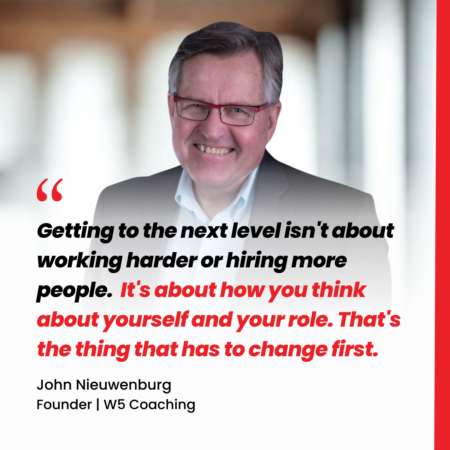
John: Yeah. When business owners reach out to business coaches, they often think the problems are in the business. But the secret I’ll share — and you probably know this as well — is all business coaching is personal coaching in disguise.
And by that, I don’t mean therapy. But what I do mean is a lot of business owners ought to be better at things like leadership, communication, and delegation. And they certainly need a shift in their mindset — in how they identify and the role they expect themselves to be leading. All change starts with first shifting the mindset that led you to where you are. If you want to get to a different place, your mindset needs to change before that happens.
Michael: So how do we change our mindset? Because there are people like myself — sometimes I try to convince myself, say a mantra every day, and that really doesn’t do anything. Is there a path that you see that works best for most business owners? Because we’re so busy trying to run a business that stopping to focus on our mindset is sometimes challenging.
John: It definitely is. Nothing and nobody will change until the cost of staying where you are becomes greater than the cost of changing.
What do I mean by that? People will stay stuck if they feel like that’s the best outcome or the best result they could get. But they can sometimes get to a place where it’s no longer acceptable. “I can’t live with it.” And so they’re willing to pay the cost, the consequence, to do the things it takes to get to the next level.
There’s actually a formula called the Formula for Change: D times V times FS has to be greater than Resistance. D is dissatisfaction. V is vision. FS is first steps. And it has to be greater than resistance. We stay stuck in resistance unless we can get this equation to move in the other direction.
Dissatisfaction is pain, fear, frustrations. Vision is wants, needs, aspirations. Dissatisfaction is typically more motivating — pain, hand on the stove. Vision has big upside, lots of possibilities, as big as your imagination could be. What has to happen is people need to get in touch with or crystallize: “My current circumstance — I’m not happy with it anymore, and I know there needs to be a better way, but I don’t know how to get started.” And that’s when they start reaching out for help.
Michael: So almost like hitting rock bottom — just exhausted, tired of it.
John: Yeah, exactly. Everyone who ever becomes a client at some point has what I call a “burning bush” — an issue that’s big enough in their business that they can’t live with it anymore. They’ve tried everything, they’re beating their head against the wall, and they say, “I need help. I don’t know how to do this.”
Michael: We mentioned mindset and the time that it takes. It’s not an overnight formula, right? It’s ongoing. And I think that’s the myth for a lot of business owners — we just want to check a box. “Okay, next. Tackle the next problem.” But we can’t do that without having more time. How do we get our time back as a business owner? I hear business owners all the time saying, “I want to do coaching. I want to take that course. I just don’t have time.”
John: It’s a paradox. But here’s the thing. I’ve yet to work with a business owner — I’m going to use some language here — every business owner I ever start with is currently doing five to seven hours’ worth of work every week they should not be doing.
Now what’s the nature of the work? Well, Mr. or Ms. Business Owner, tell me what’s on your “Oh Sh*t” list. What’s that? Tell me about the list of things where every time you have to do payroll or receivables or another quote, some part of you says, “Oh, I have to do this.” That’s a clue. You shouldn’t be doing that work anymore. That work can be done capably — and in fact better than you — by someone for $20 an hour. Nowadays, because of the internet, I can get you an engineer overseas for $20 an hour that can do all the quoting you need if you’re in trades.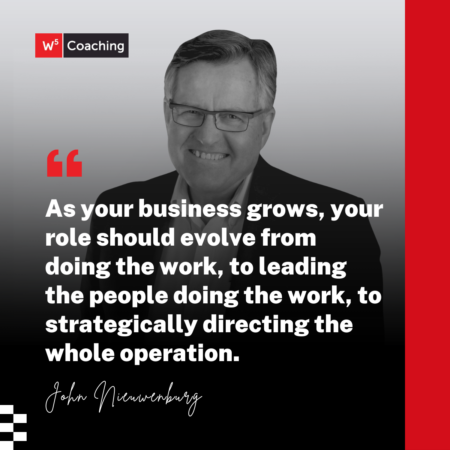
And what does that free you up to do? It frees you up to do work that’s worth $200 an hour to the business. Or you get to make a choice — you can go to your kid’s hockey game. Right now, you’re trapped. You’ve got handcuffs. And those handcuffs come from a mindset.
A lot of the owners I work with are tradespeople — home services, electricians, that kind of thing. They start out with a tool belt, they get a truck, and they’re busy. Now it’s two trucks and three trucks, now it’s five trucks, but they’re still operating the business with the mindset of “I’m the electrician who has tools and works in my business.” The shift that has to happen is: no, you’re a business owner that happens to do electrical work. That’s the first shift, because that mindset changes how you think about your business. You can’t be on tools anymore if you’ve got 10 trucks. Your time is not best spent with tools in your hands.
The example I like to think about as a metaphor: You’re in the Navy. You’re a captain of a 50-foot boat and the crew is 10, and you’re the most qualified engine room guy — you’re the best electrician. How often is that captain in the engine room with tools? All the time. Maybe he’s got a helper.
Okay, well — let’s make you a captain of a 150-foot boat. Now the crew is 50. How often is that captain in the engine room with tools? Better be close to never, because now that captain ought to have a guy who’s the engine room guy. And if there’s a fire, of course he’ll jump in. But now his role is different. He’s got to be the leader of not just the engine room, but every other department on the boat.
Now let’s make you a captain of an aircraft carrier. There are 2,000 people on board. How often is that captain in the engine room at all? Maybe to give somebody a 20-year service certificate. Because that captain now has a person who manages the person who’s the engine room guy.
The title’s the same, but what you do and how you create value and what leadership looks like completely changes at each of those three levels. And if you want to get from 10 trucks — or get your life back — how you think about your role and what you focus on has to change to line up with what the business needs from you. If the owner wants a better business, first the business needs a better owner.
Michael: Speaking of employees, I often hear this question: “I’m a solopreneur, I’m good at what I do, how do I get the jobs, do the jobs — and I don’t have much money left to hire somebody because I also have to pay an accountant and this, that, and the other.” There seems to be this yo-yo effect of “I can afford an employee — no I can’t — I need to go get more sales — well, to get more sales, I’ve got to go fulfill the job.” They’re stuck in that place. What are some of the things you’ve found — how can they get sales, do the job, hire people, and afford people?
John: Well, the first question I ask is: what’s your actual gross margin? And lots of business owners say, “What’s that?” Okay, well, that’s the problem. If you don’t know what it is, you’re clearly not getting enough gross margin to make a business that’s profitable and affordable.
Often, business owners in the trades confuse markup with gross margin. And when they do, they’re not getting the result they want. The second thing is lots of business owners are very bad or tardy about receivables. They’ll have receivables that are 120 days out and they’re wondering why they don’t have any cash. And the third thing is — do they actually have a cash flow forecast? Can they actually predict how much cash is coming into the business? Most don’t. Which is in effect the same as getting on an airplane where the pilot doesn’t have a navigation plan. How’s that going to work out? Not very well.
So there is some investment. There’s a leap of faith. And lots of times we make stairstep changes in how the business grows. But there are almost certainly mechanics in the business that aren’t correct. If what you’re saying to yourself is, “I can’t afford to hire somebody,” what you really want to be saying is, “I can’t afford not to hire somebody.” Now — what would have to be true for you to believe that’s true? Well, you need a lot more certainty about some of the things you probably don’t understand well enough: cash flow, margin, working capital. There’s a gap between paying payroll and getting paid for it yourself.
I have a client who in March did twice the business he did in December. Over that span, he’s doubled the size of his business. And he’s wondering, “My P&L says I’m profitable, but I don’t have any money. Why?” Well, let me explain working capital. Let me explain the cash gap. Let me help you understand what happens when you grow that fast — how much that stresses cash flow. Your business is great, but there’s a consequence of the success you’re having. Understanding what it is and then managing it is what’s going to help you get to the next level.
Michael: There are a lot of moving parts, and each business is unique. Some people have more resources, some people have less, some people have a natural leadership style or sales style. So let’s talk about when you’re ready for that employee — how can we find a good employee and how do we keep them? I know that’s a hot topic too.
John: It is. Technical people tend to put too much emphasis on technical skills when they’re hiring. But here’s an important thing to consider: people don’t get fired for skills. They get fired for culture — bad attitudes, being late, bad work habits. So if you want a great employee, hire for culture first. Technical skills you can teach.
I’ll put it a different way. I’m in Canada, so we think about hockey an awful lot. The team that wins the Stanley Cup doesn’t necessarily always have the highest level of talent, but they will have the best culture of any of the teams. Now, most business owners think of culture as an afterthought — kind of like a cherry on top. What I’d say is that it’s actually foundational. If you get the culture right, almost everything else becomes easier.
Leadership is about setting expectations, setting how people conduct themselves, and then holding people accountable for those results. And that’s what culture ultimately is. Or put a different way — what the team actually knows to be true is: whatever you tolerate is what the culture is.
I’ll put it another way. You’ve got 10 people. I’ve asked this question a lot: if you could start your business again, how many of the 10 would you rehire? The most common answer I get is about half. So are you telling me, Mr. or Ms. Business Owner, half your people are annoying the other half? Half your people are frustrating your customers? And you’re wondering why you have problems?
Why do you put up with that? You’re tolerating it. You’re accepting it. You say, “Well, I’m stuck.” You’re only stuck because you choose that as the outcome. You’re not stuck. You choose not to solve it. Get the culture right first.
I’ll use another metaphor. Why are the Ten Commandments written in stone? We don’t debate them. “Thou shalt not kill” is a commandment. All right — well, show me your culture. Show me your commandments. What are people expected to behave like? How do you hold them accountable if they don’t behave that way? How do you reward them when they do? I’ll teach you the technical skills, but let’s be clear about what we expect in terms of behaviour — how people relate to each other, how they relate to the customers, how they treat our vendors, our supply houses. Get the culture right, lots of other things become easier. If you don’t get the culture right, you’ll be complaining about staff that are late and people not doing good work. All of that matters, but it starts with the foundation: culture.
Michael: It’s almost like road signs, right? If every road didn’t have a stop sign, a speed limit — people would just drive erratically. And that’s really what a business is without rules.
John: You know, I have a way to help think about complexity. If there are three people in a room, how many handshakes need to take place so that every person shakes everyone’s hand? The answer is three: A and B, B and C, A and C. There’s a formula for this.
Well, let’s get to 10 people. Now the total is 45. So what’s happened? We’ve grown the business by a multiple of three, but we’ve grown the complexity by a multiple of 15.
When there are three people in the room, it’s easier to set the tone and culture — you’re talking to everybody all the time. When you have 10 people, complexity rises to the level where your individual capability of setting the tone and teaching people can’t rely on you telling everybody every minute what needs to be done.
Or put a different way — how do they get those French fries to taste the same in your town or mine? And the fries are made by a 16-year-old whose parents can’t get him or her to clean their bedroom. How do they do that? They have great systems. It’s a recipe. It’s a formula. They can do it over and over again anywhere in the world.
Now, I get a lot of pushback on that because some owners say, “Well, I don’t make fries. I make custom cabinets. Every job I do is particular.” And what I would say to that is — would you be willing to undergo an operation if the surgeon and the operating room nurse didn’t follow a checklist? “I started with 30 scalpels but I only count 29, and we’ve already buttoned up the patient.” Even in the work of a surgeon — very highly specialized, very highly trained — they still need systems to ensure they perform work at the same high standard time and again.
Would you get on an airplane if you knew the pilot didn’t do the pre-flight checklist? “Hey, this pilot’s talented. He’s good. He’s done this a hundred times.” Why do they do the pre-flight checklist? To make sure it’s done exactly right every time. Because people’s lives depend on it.
Michael: What’s some insight on this — I had a business owner who was beginning to implement some systems, but he was frustrated because people couldn’t use their best judgment about when to bypass a system. They had cleaning policies for a showroom, but they also had two hot jobs in the plant. And he was saying, “Why couldn’t they figure out that these jobs are more important than the cleaning process?”
John: About 85% of what happens in a business ought to be a routine. We have a system. This is how it’s done. About 15% of the time, stuff happens. Exceptions happen.
When that cleaning team was sent to that facility, they were sent with a level of autonomy and authority to do what was expected. But they weren’t clear about what the rules were on what required escalation. Clearly that circumstance called for someone to say, “I’m not sure what to do. I know what I was sent here to do, but circumstances have changed. I probably need to consult with somebody.”
Back to the fries: one afternoon we run out of potatoes. We don’t know what to do. Guess we better phone the boss at 10 o’clock Saturday night. “Hey, we ran out of potatoes. What should we do?” All right, well — that’s one of those exceptions. But what happens on Monday is we don’t look for a people solution. We look for a system solution. What would have to be true so the next time we run out of potatoes, people in the restaurant would know what to do? They wouldn’t need to phone somebody at 10 at night. Let’s create a systematic solution so that every time we identify exceptions, we have a way to handle them.
In that example you described, the degree of autonomy and authority weren’t clear enough to the team. In that circumstance, they should have consulted — they were expected to consult with whoever the team leader or owner is. And that’s another example of an owner becoming better in how they delegate.
Michael: My answer exactly. I said, “Let me see your schedule. Were they aware of the jobs? Were they aware of the big jobs coming right behind those two?” I said, “Next time you need to figure out why they didn’t know how to make that decision — because the process over here clearly says here are the steps, but they didn’t have enough information.” A lot of business owners’ frustration is “I don’t want a bunch of robots here that can’t make their own decisions.”
John: Yeah. You do want to be clear with people about what level of autonomy and authority they have — that they can execute what you’ve agreed on as the expectation. You’re not looking for robots. But you are looking for people that have enough judgment to know, “This is an exception and I need to get some help with it.”
Michael: Well, I also know sales and marketing is a big deal for business. I believe founder sales tops most sales. But what should a business owner be working on when it comes to sales and marketing? Is it face-to-face outside sales, inside sales, putting the sales playbook together, working on marketing? I see so many business owners just dabbling in so many things.
John: There’s an order in which you escalate what you do with your time. The first thing you should get off your plate is anything on your “Oh Sh*t” list. That’s what a VA does — handling the rings, pings, and dings. Your inbox, your calendar, the phone, all of the things that interrupt you.
Once that’s clear, the next thing to get off your plate is anything it takes to deliver the promise of the business. Whatever your business does, the person responsible for delivering it — that person becomes your VP of operations, so to speak. You get that off your plate and now have someone senior enough to carry out that mission for you.
The next thing that comes off your plate is everything it takes to generate leads. There ought to be a systematic, tactical marketing plan. But first, there needs to be a revenue and profit plan. What’s the forecast? What are we expecting in terms of sales? Then we can reverse engineer: what do we need in terms of leads, conversion — whatever that is for your business? How can we reverse engineer it so we know we’re getting enough leads to reach the revenue we’re expecting?
And then once we know that, we can create a sales system to deliver against it. That’s the last of the four things I just described — the last thing that comes off your plate. So when you talk about founder sales, I completely agree. When you’ve got enough leads coming into the business that you can hire someone on commission to take over that role — that’s the time you can delegate it.
If a salesperson is expecting $100,000, we can reverse engineer how many sales that person needs to make and how many leads it takes to make that number of sales. When we achieve those levels, we can take sales off your plate.
Michael: I know sales is difficult these days because there’s so much noise — a lot of digital, now we’ve got AI and all these things. How can a founder or business owner get better at sales in today’s world?
John: If you’re a tradesperson, how long does it take to become a red seal electrician? Five years. You’re a professional. The other kind of clients I work with are professional advisers — lawyers, accountants, physiotherapists, dentists. How long does it take to become a lawyer? Seven years. All right — well, how much business training did you get? Did you get any sales training? You didn’t.
So you’re great at being a lawyer, but you’ve never given yourself the benefit of learning how to sell. It’s a skill. It’s repeatable. You can learn how to do it. I can help you with that. But it requires applying yourself to an area you’re not yet developed in. So why don’t we just name what it is and then help you figure out how to become better at selling whatever it is you do in your business.
Michael: So we need to be a salesperson, a leader — we need to do a lot of things right as business owners. But the one thing I continually hear you say is: take off the belt. You don’t need to be on the job. You have other things to focus on. Correct?
John: Correct. The shift that has to happen is this: many people rise to the level where they think, “I’m an electrician that owns a business.” And the shift I’m talking about is — no, you’re a business owner that happens to do electrical work, or home services, or carpet cleaning, or whatever it happens to be. When that shift happens is when you actually become a leader-owner instead of an operator-owner. And that doesn’t happen until you shift your mindset — how you think about what your job is, what your role is. What it looks like is you’re no longer putting on a tool belt.
I use a statement from time to time with owners who really had a hard time with that mindset shift: “When you’re estimating a new project, don’t think about how I’m going to get this done. Think about who I’m going to have do it.” That way you’re taking yourself out of the equation.
Michael: That’s a fabulous thought.
John: That shift also comes with this. There’s a way better question you ought to be asking yourself. Not “How can I get this done?” but “How can this get done?” The only word I took out of those two sentences is the word “I.” “How can I get this done?” is not the same as “How can this get done?” And as soon as you ask yourself the second question, you start thinking about it very differently.
Michael: You mentioned numbers earlier. Any advice? I know contractors — most of us don’t have a financial mindset. We didn’t go to accounting school. What are some of the basics that a business owner needs to know? Where do you start?
John: Yeah, I have a bit of a rant on this topic. The small business owner community is very badly served by the accountants who serve small business owners.
Now that sounds like a slag on accountants, but it isn’t. The issue is there’s a very different set of expectations. What does an accountant who serves small business owners think their role is? Taxes, compliance, and year end. “That’s what I do. I supply that information to you.” Business owners then have questions about what the numbers mean, and they go to their accountant, and their accountant — at this level — isn’t equipped to answer that question. They give a bad answer, and it leaves the business owner confused, uncertain. They’re embarrassed because “I’m talking to my accountant and I don’t know what he’s talking about.” But here’s the truth: the accountant doesn’t know what he’s talking about either, because the kind of accountant you need is someone who has a strategic view of the business. They’re CFOs.
If you’re a million-dollar business, you don’t have a CFO and you probably can’t even afford a fractional CFO. But you need someone who can look at your numbers and help you understand what they mean. Because of how things are set up, your accountant is often not that person.
In fact, many of the books I see don’t properly account for cost of sales, and as a result can’t properly account for gross margin. Why? Materials and everything are in the cost of sales, but often all labour is in a labour category — in indirect expenses. There isn’t a portion of labour attributed to cost of sales. And when you go talk to an accountant about it, there’s a lot of resistance to making that change, and they don’t know why. It’s gobsmacking.
I’ve had lots of conversations with accountants where I’ve had to force a circumstance where we split apart fixed labour and indirect expenses so we could put all direct expenses into cost of sales and get an accurate gross margin — a real gross margin.
Part of the value of a business coach, at the level of the businesses I’m working with — that $500,000 to $3 million range — is I’ll act as your CFO. Now, I can’t take fiduciary responsibility. I can’t guarantee the numbers are correct — that’s not what I’m able to help you with; your accountant should be doing that. But I’ll help you understand what the numbers mean. I’ll help you understand what you should be doing differently, what’s working, what’s not working, and what needs to change to make things better.
Michael: There’s a lot to this, right? That’s why it’s always good to ask for help. We’ve talked about a lot of things today. So can you kind of revisit — I know a lot of business owners say, “If somebody just gave me a step-by-step plan, I could crush it.” Can you give us those high focal points so listeners can wrap this all together?
John: I’m going to answer that a little differently than the question you raised. I’ll start by telling a story.
When I first started as a business coach, I was trying to answer the question you just asked. “Let’s do a strategic plan. Let’s do a business plan. Let’s map out what our engagement for the next 12 months is going to look like.” And I was working with this particular owner for about three or four weeks. In about week four, I said, “Hey, you’re not very engaged with us. You’re not really contributing much to it, and you don’t seem like this is a thing for you.” And he looked at me square in the face and said, “I don’t know why we’re doing this, John. I can’t make payroll tomorrow.”
And I realized I was a doofus. He’s right.
What I’ve learned is that when I first start with a client, there’s always a burning bush. In his case — “I can’t make payroll.” In lots of cases it’s “I’m working 70 hours a week.” So the first thing we have to do in any engagement is take the pressure off. Fix the thing, whatever that thing is. And then we have the breathing room and the space to go about systematizing the business. There’s a five-step framework I use — there’s a systematic way to answer the question you’re asking. But before we start applying that process, the first thing we’re going to do is fix whatever the burning bush is. There’s always a burning bush. Always a thing that’s so painful that it’s what causes them to reach out.
I just started with a new client — the client owns a very successful bakery. They have 27 people in total, with four team leads. One of those team leads quit. That business owner was back in the bakery at 4 in the morning for three months, and then said, “I can’t do this again.” Well, let’s solve that problem first. Because we can’t have it where if somebody leaves, you’re back in the engine room for three months to fix that before you can get a replacement.
That’s another example of a burning bush. And the burning bush is always pretty clear, pretty evident when you first meet a prospect. The first couple of meetings, you know for sure what needs to be done first — in order to give that business owner some space, some peace, some perspective to help them think, “Okay, I got that solved. Now let’s figure out the bigger picture.”
Michael: Yeah. In other words, pivot — and that’s the name of our podcast, Small Business Pivots. In my opinion, there are no certain steps. It’s whatever that burning bush is. That’s what we need to address because right behind it there’s going to be another one, and eventually you’ll have a lot of the big bushes extinguished, but you’re still going to have some.
John: Among the first things in the first meeting is I have the business owner benchmark their business against a standard — 21 “silver bullets,” both quantitative and qualitative. I have them identify what is and isn’t working in their business. That gets adapted — what isn’t working, what is and isn’t relevant — and we adapt it to the circumstances of the business. But before we start implementing that in the structured way I’m describing, it’s, “Let’s fix the thing first — whatever that thing is — and then we can proceed from there.”
Michael: Well, you’ve helped us a lot with business owners. How about yourself? How do you help? Where can we find you?
John: My business name is W5 Coaching — w5coaching.com. You’re probably wondering what W5 is. I told you earlier about the Socratic method of leadership — the best way to help somebody is to help them figure it out for themselves. And how do you do that? You help them think. And how do you do that? You ask really good questions. The five core questions: who, what, when, where, why. So — W5. Hopefully that’ll help you remember.
Michael: I love that. Are you on social media where people can find out more?
John: Facebook, Twitter, and LinkedIn. All the usual platforms. W5 Coaching — it’ll lead you to all of the information you might like to have.
Michael: I try to end with one question unique to our show. I know a lot of business owners are embarrassed — they have this facade that they’ve got it all together. They can’t let the public see their weaknesses or challenges. I’ve been told that business owners are resistant to asking for help. Do you have any words of encouragement or advice to say, “It’s okay — come talk to us”?
John: Yeah. They don’t — until the pain is so great that the pain of staying where they are becomes too much. There’s a wonderful TED Talk by a woman named Brené Brown. In it she talks about the power of vulnerability — it’s only had 65 million views. Most of us resist being vulnerable. And the point of her story is: when we see vulnerability, it’s actually very attractive. People are drawn to people who are willing to be vulnerable. Why? Because it’s so rare to see. What you think you’re resisting because of your fear is actually the way through.
I’ll put it a different way. Ryan Holiday wrote a book called The Obstacle Is the Way, which is a riff on the Roman Stoics. And the point he makes is: whatever you think the obstacle is, that’s the clue. That’s the target. That’s the thing you have to solve. The obstacle is the way.
Or — I told you I was a hockey fan. There’s a guy named Trevor Linden who was the captain of the Vancouver Canucks. His way of saying it: what you resist persists. Whatever it is you’re resisting, that’s the thing you need to solve. And as soon as you’re willing to take it on is the sooner you’re going to get through it.
I have a metaphor for this. A lot of business owners will put up with a toothache. It’s uncomfortable. They chew on the other side. But they just kind of live with it. What they’re really doing is tolerating a toothache because they’re afraid of the root canal. The root canal is very painful at the moment, but ultimately that’s the thing that leads to the solution. Now, here’s the thing about a toothache: it never gets better. There’s only one direction that thing’s going to go — it’s just going to get worse. So where on that path from toothache to root canal would you like to get some help? At the root canal stage — or when it’s still early? It’s a choice. If you recognize you have a toothache, ignoring it doesn’t make it go away.
Michael: Amen. What you resist persists. Well John, you’ve been a pleasure today. You’ve shared a lot of valuable information. Anything we didn’t cover that you’d love to shout out?
John: No, thanks for the time. I’ve appreciated having the space to have a chat about business owners and some of the challenges they face.
Michael: Fantastic. I wish you continued success and thank you again for your time.
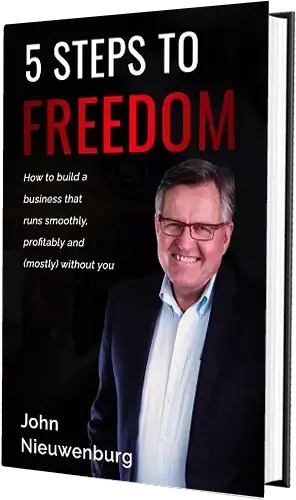
Build a Self-Managing Company
How to build a business that runs smoothly, profitably, and (mostly) without you.
Feeling stressed out and overwhelmed with a business that is taking all your time - and not giving you enough in return?
Are you finding it challenging to hire the right team (and get them to do the right things)?
I wrote this little guide for you!
Enter your details below to receive your free copy!