
Why Your Key Employee Has More Leverage Than You Do


John Nieuwenburg
John Nieuwenburg has been a professional business coach since 2004. Prior to becoming a coach, he held executive positions with Tip Top Tailors and BC Liquor Stores. In 2019, MacKay CEO Forums awarded him with Canada’s CEO Trusted Advisor Award in the Small Business category. Since becoming a coach, John has worked with over 400 clients, taking them through a systematic process that helps them feel organized, confident and in control of their businesses.
Can You Say No When a Key Employee Asks for a Raise?
Shane Parrish makes a point in his book Clear Thinking that I come back to often with business owners.
The best decision-makers aren’t always the smartest people in the room. They’re the ones who rarely get forced into a decision.
As Parrish puts it, “Anyone looks like a genius when they’re in a good position.” He adds that “even the smartest person looks like an idiot when they’re in a bad one.”
In small business, I see this most with staff.
Your key employee walks into your office and asks for a big raise. Or tells you they’re thinking about leaving. And your stomach drops.
You know what happens if they go. Nobody else knows their job. Your customers know them better than they know you. It’s all in their head.
So you say yes to a number you can’t afford.
Saying yes under pressure is a forced decision from a bad position
 When you cave in that conversation, your position makes the decision for you. That happens to smart owners all the time.
I have a client who owns a small plumbing business. He doesn’t want to be on the tools anymore, so he has one plumber doing most of the work.
That plumber asked for five days off. My client didn’t want to give them to him, but he felt he had no choice. The week after the time off, the plumber didn’t show up on Monday. He didn’t show up on Tuesday either, and he didn’t call. He walked in on Wednesday.
My client was mad. But what could he do? He was stuck, and he was stuck because he’d let himself become stuck. He had no options.
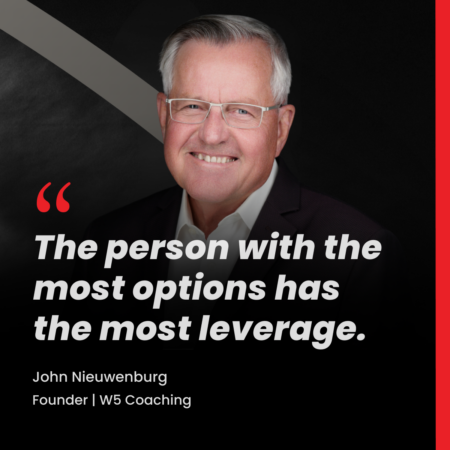
Business ultimately comes down to leverage. You have leverage when you have options. You lose it as soon as the other person has more options than you do.
When one person leaving would disrupt your business, every request they make carries that weight. “I want a raise.” “I want five days off.” “I want a longer vacation.”
Most owners respond by giving a little more to keep the person happy. That works for a short period of time. It doesn’t work in the long term, because your position hasn’t changed.
The time to fix this is long before anyone walks into your office.
Always be recruiting, so you know who you’d call if you had to
 That’s why I tell every owner I work with to always be recruiting. The point is to know who you’d call if you had to, even when you have no plans to replace anyone.
I learned this when I was 22, as the manager of a menswear store in Calgary. This was the ’70s. The oil business was booming and the city was growing fast. Nobody was moving to Calgary to work in retail.
My boss and I would walk the mall where my store was. My job was to point out the two best salespeople in the mall who weren’t working for me yet.
Then I got to know them. I’d make a point of bumping into them in the food court and having a coffee. Or I’d stand outside their store for a few minutes and watch them work with customers.
So if one of my people quit, I already knew two very good replacements. I had built a relationship with both of them. I could likely hire one or both in short order. When someone told me they were leaving, I could wish them well and make a phone call.
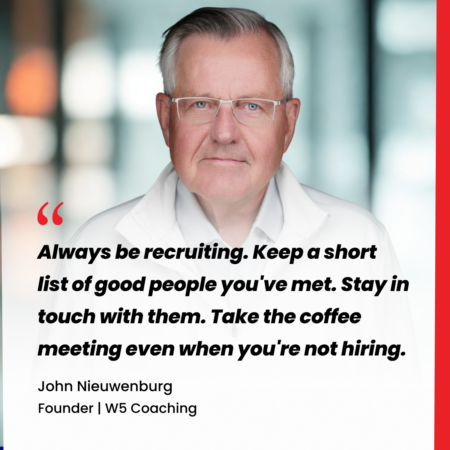
You can do the same thing in your business today. Keep a short list of good people you’ve met. Stay in touch with them. Take the coffee meeting even when you’re not hiring.
It’s like having a spare tire. You hope you never need it, but you drive more confidently knowing it’s there.
Your staff can tell when nobody else can do their job
Your staff know when you’re stuck. They can tell when nobody else in the business can do what they do.
Most of them aren’t looking to use that against you. But it sits underneath every conversation you have with them, whether either of you mentions it or not. You created that by letting the business come to depend on one person.
Once you have options, a request for a raise becomes a conversation between two people who both have choices. That’s healthier for everyone.
Good people don’t need you to be stuck. They want to be paid fairly and treated well.
The person with the most options has the most leverage
So when your key person asks for that raise, you can listen calmly. You might still say yes. They might deserve it. And if they haven’t earned it yet, you’re in a position to tell them so honestly.
Either way, you get to decide on the merits of the request.
Who would you call if your key person quit tomorrow? Working out that answer is a good use of a 15-minute call. Book a 15-minute call with me.
Our proven business coaching program has delivered results to over 400 clients
Business coaching can help you:
- Improve operations, implement systems and remove bottlenecks so that you get your time back
- Hire and train the right team and eliminate people problems
- Grow your business with bigger and better clients
- Overcome cash flow issues and improve your financial management
- Make better decisions and become more profitable
When your business runs well, you get your life back.
Services are confidential.
Click here for full details or click the red button to schedule a complimentary 15-minute call.

Coaching only works when there's a good fit between coach and client. If you'd like to explore coaching, book a confidential 15-minute call so we can get to know each other.
More on recruiting, building backup into your team, and having hard conversations with staff
How to Create Operational Redundancy without Doubling Your Staff
Three ways to make sure more than one person can do each key job: document your SOPs, cross-train your team, and split roles between part-time staff.
An old school approach to recruiting
More on how I built a bench of salespeople in a Calgary mall, and how to bring sales and marketing thinking to hiring so you’re never recruiting in a crisis.
3 tips for recruiting when employees are hard to find
How to attract more candidates, write a job ad that sells the role, and set up a recruiting system that runs all year.
Why you’re having trouble recruiting
Why the old way of hiring (post a job ad and wait for applicants) no longer works, and how to bring a marketing mindset and a repeatable system to recruiting.
The Leadership Skill Most Business Owners are Avoiding
Why owners put off difficult conversations with employees, and how to have them by finding common ground on the facts first.
Want Better Performance? Tell People Where They Stand.
Why saving feedback for the annual review leaves your people guessing, and how small, regular doses of feedback help your team correct course on their own.
Build a Self-Managing Company
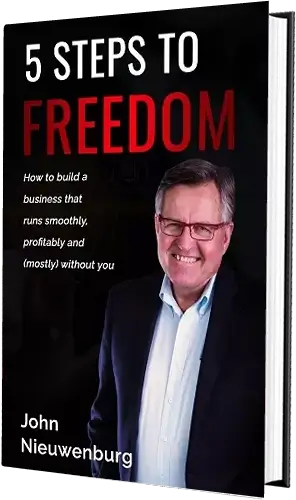
How to build a business that runs smoothly, profitably, and (mostly) without you.
Feeling stressed out and overwhelmed with a business that is taking all your time - and not giving you enough in return?
Are you finding it challenging to hire the right team (and get them to do the right things)?
I wrote this little guide for you!
Enter your details below to receive your free copy!