
What I Told the Profit Answer Man About Building a Business That Supports Your Life


John Nieuwenburg
John Nieuwenburg has been a professional business coach since 2004. Prior to becoming a coach, he held executive positions with Tip Top Tailors and BC Liquor Stores. In 2019, MacKay CEO Forums awarded him with Canada’s CEO Trusted Advisor Award in the Small Business category. Since becoming a coach, John has worked with over 400 clients, taking them through a systematic process that helps them feel organized, confident and in control of their businesses.
I recently joined the Profit Answer Man podcast to talk about what really gets in the way for small-business owners.
You can listen to the full episode here or read the summary below.
Most of the business owners I work with are very good at what they do.
They’re lawyers, electricians, health practitioners, tradespeople, but they didn’t get any real business training.
It might have taken them five or seven years to learn their profession, but when I ask, “How much business training did you get?” the answer is usually “none.”
They’re often struggling with time, team, or money.
They say things like, “I’ve got too much to do and not enough time to do it,” or “If I don’t do it, it won’t get done.”
Hiring good people is hard.
Getting the culture right is hard.
And then there’s money. Both understanding it and earning more of it.
Here are some insights that can help:
1. Most small-business owners are badly served by their accountants
Small-business owners are badly served by their accountants.
That’s not because accountants are bad people.
It’s because most accountants think their job is to do year-end, taxes, and compliance.
But most business owners don’t really understand their numbers.
What a P&L means, gross margin, or any of that.
And when they ask their accountant about it, the accountant doesn’t know how to explain it.
That leaves the owner frustrated. I’ve heard it so many times:
“I go to my accountant and say, ‘I think I’ve got cash problems. I don’t feel profitable,’ and they say, ‘No, you’re fine.’”
Owners at the $1–3 million mark can’t afford a CFO, but they still need the perspective of one.
That’s why you need to build a simple dashboard.
The 3–5 key numbers that tell you how your business is doing right now, not three months ago.
Getting last month’s P&L is like trying to look at your business through the rear-view mirror of a car.
It’s water under the bridge.
A dashboard lets you act while it still matters.
Just like watching the fuel gauge or the speedometer when you drive.
2. Run your business with a plan, not by the seat of your pants
A lot of owners at this size run their business by gut feel.
When things slow down, they chase customers.
Then they get busy and stop selling, and the cycle repeats.
Would you get on an airplane if you knew the pilot didn’t have a navigation plan or a map for how to get from here to there?
Of course not.
Yet most people run their business that way.
You need a plan that maps out what your revenue will be over the next twelve months.
From that, you can see what marketing needs to happen to support that revenue, and what delivery capacity you’ll need to fulfill it.
That’s how you avoid the seesaw of “I have lots of customers but don’t have help,” followed by “Now I’ve got help but not enough customers.”
3. A business that works sits on a three-legged stool
A successful business is like a three-legged stool.
First leg: Systems run the business. People run the systems. You lead your people.
If people run the business, the business rises and falls on the quality of those people.
If systems run the business, the people can come and go and the business still runs well.
That’s how McDonald’s get the fries to taste the same in your town and mine.
They’re made by a sixteen-year-old whose parents can’t get them to clean their room, but McDonald’s has great systems.
You may not be making fries, but the principle applies everywhere.
Second leg: Systematize the routine and humanize the exception.
About 85 percent of what happens in a business should be routine, SOPs, checklists, “this is how we do it.”
The other 15 percent is the part that takes judgment and creativity.
Third leg: When something goes wrong, look for a system solution, not a people solution.
If the team runs out of potatoes and calls the manager at 10 p.m., the next morning the question should be, “What would the system have to be so this doesn’t happen again?”
That’s how you build a business that keeps running without you in the middle of every fix.
4. Change happens when staying the same is too painful
I once worked with a client who ran a factory with two shifts.
The first shift started at 6 a.m., the last ended at 10 p.m.
He had an hour’s commute, so he slept on the office couch three nights a week, for ten years.
One day his wife said, “Your business is your mistress. If you don’t do something about it, I will.”
That was the moment he realized he couldn’t keep paying that price.
Most business owners reach a point where what they’ve been doing stops working.
When it becomes painful enough, change becomes the easier path forward.
5. Great leaders have crucial conversations
A crucial conversation is any conversation where emotions and stakes are high.
Every leader faces them.
Great leaders are the ones most willing and most capable of having them.
When we face conflict, most people either avoid it, fight, or handle it badly.
If you’re going to have these conversations anyway, wouldn’t it make sense to get good at them?
There’s a great book called Crucial Conversations.
I often suggest clients turn it into a kind of book club, read a chapter each week over lunch and practice together.
Getting good at crucial conversations improves every other part of your business: delegation, systems, and culture.
6. Always be recruiting
Hiring is one of the hardest things for owners.
Most only start recruiting when someone quits, and by then it’s a crisis.
When I was 22, managing a menswear store in Calgary, my manager and I would walk the mall every three months.
My job was to point out the two best salespeople who didn’t yet work for me.
That meant when I needed someone, I already had relationships started.
You have to build a bench, a back-up plan.
That way, when a team member shows up late for the third time in a week, you’re not stuck biting your tongue because you have no options.
7. You don’t get the culture you want. You get the culture you deserve.
Culture isn’t the cherry on top. It’s the foundation.
You don’t get the culture you want. You get the culture you deserve.
That means you get the culture that results from how you behave, the signals you send, and what you tolerate.
If you want a great culture, you have to work at it and live it.
Hire for culture, train for skills.
People rarely get fired for lack of skill.
They get fired for lack of cultural fit.
Yet too many owners hang on to people who hurt the culture because they value the person’s skills.
8. The purpose of your business is to support your life
Here’s the bottom line.
The purpose of a small business, the kind doing one, two, or three million a year, is to give its owner the life they want.
The purpose of your life is not business.
The purpose of life is to live your life.
If your business isn’t supporting your life, what is it supporting?
Most owners went into business for freedom and for money.
If you don’t have both time freedom and financial freedom, your business is broken, and it’s fixable.
If you’d like some help getting your business to truly support your life, let’s talk about what that would take.
You can book a call with John to start a conversation about building a business that gives you both time and money freedom.
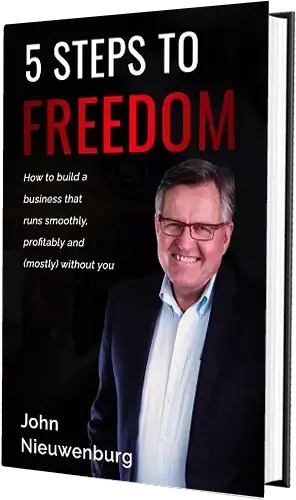
Build a Self-Managing Company
How to build a business that runs smoothly, profitably, and (mostly) without you.
Feeling stressed out and overwhelmed with a business that is taking all your time - and not giving you enough in return?
Are you finding it challenging to hire the right team (and get them to do the right things)?
I wrote this little guide for you!
Enter your details below to receive your free copy!