
Why Weekly Commitments Work


John Nieuwenburg
John Nieuwenburg has been a professional business coach since 2004. Prior to becoming a coach, he held executive positions with Tip Top Tailors and BC Liquor Stores. In 2019, MacKay CEO Forums awarded him with Canada’s CEO Trusted Advisor Award in the Small Business category. Since becoming a coach, John has worked with over 400 clients, taking them through a systematic process that helps them feel organized, confident and in control of their businesses.
Why Does the Important Work in Your Business Keep Getting Pushed to Next Week?
You know what needs to happen in your business.
The numbers need fixing. A role needs clarifying. There’s a hire to make, a price to raise, and a job you should have handed off years ago.
None of it is a mystery. And yet the same items have been on your list for months.
Your phone rings, pings, and dings all day. Every week something urgent needs your attention.
And every week, the important work gets pushed to the next one.
What breaks that pattern is a weekly commitment. A set time, every week, to decide what you’ll get done before next week and to look honestly at what happened to last week’s commitments.
I see how much this matters in my coaching work. After the first few months, clients often say some version of this:
“I know what I need to do. Maybe we should meet every two weeks so I have more time to execute.”
On the surface, that sounds reasonable.
But in my experience, every two weeks usually works worse, not better.
The value of a coaching session comes from the cadence the meeting creates, as much as from anything we talk about during it. And the reasons why apply to any owner trying to move their business forward, whether or not you ever work with a coach.
We’ve been organized around weeks since the first day of school
Most of us have lived on a weekly rhythm our whole lives.
Monday starts the week. Friday closes it. Weekends create a natural reset.
Businesses run weekly meetings. Teams review weekly priorities. Salespeople track weekly activity. Leaders often think in terms of, “What needs to happen this week?”
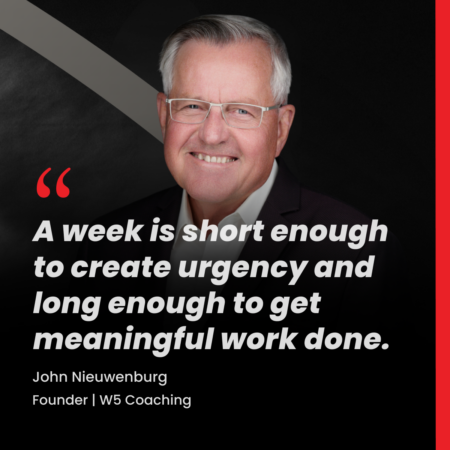
A week is short enough to create urgency and long enough to get meaningful work done.
That makes it a powerful unit of accountability.
When the question is, “What will you accomplish before we meet next week?” the commitment tends to be specific and immediate.
When the horizon becomes two weeks, there is more room for delay.
“I have lots of time” becomes “I’ll get to it next week.”
And then the urgent starts crowding out the important.
The weekly check-in is part of how the work gets done
A client may think, “If I skip this week’s coaching call, I gain an extra hour to work on the business.”
Technically, that is true.
But practically, the coaching session is often part of the execution system. It helps answer:
- What matters most right now?
- What did I commit to last week?
- What got in the way?
- What changed?
- What decision needs to be made?
- What am I avoiding?
- What needs to happen before next week?
Those questions are worth answering every week.
That hour often improves the quality of many other hours.
Some weeks the meeting only needs 20 or 30 minutes. That’s fine.
The length can flex, as long as the meeting still happens every week.
The early wins come fast, and the deeper changes take months

There’s another reason the weekly commitment gets harder to keep a few months in.
In the beginning, progress can feel very fast. There are usually obvious problems to solve:
- Fix the numbers
- Clarify roles
- Hire someone
- Stop doing low-value work
- Improve pricing
- Build a dashboard
- Create a sales process
- Delegate something the owner should never have been doing
These changes can produce visible results quickly.
Later, the work often gets deeper. Now you are changing:
- Habits
- Leadership behaviour
- Team capability
- Trust
- Decision-making
- Culture
- Systems
- Management routines
- The owner’s role in the company
Those changes often move much more slowly.
That does not mean nothing is happening.
Most of the time, progress is slow and hard to see. Then something shifts all at once.
A hiring process that seemed stuck suddenly produces the right person.
A team member who resisted accountability finally steps up.
A delegation process that felt awkward starts working.
A pricing change that took months to implement suddenly shows up in the P&L.
An owner who has been trapped in the business finally realizes the business can function without them.
The visible breakthrough may happen in a day. But the conditions that made it possible have been building for months.
A weekly rhythm keeps you close enough to see the small shifts
When we meet every week, we can see the small shifts.
We can catch problems while they are still small.
We can adjust faster.
We can recognize when something that looks like lack of progress is actually part of a longer process.
We can keep momentum during the periods when the business does not appear to be changing very much.
And we can move quickly when the breakthrough comes.
Every two weeks doubles the length of the feedback loop
The biggest cost of moving to every two weeks is a longer feedback loop.
Instead of Decide → Act → Learn → Adjust every seven days, the loop runs every fourteen days. That means:
- Fewer course corrections
- More time for assumptions to go unchallenged
- More time for difficult decisions to be postponed
- More opportunity for urgent work to crowd out important work
- More time spent at the next meeting reconstructing what happened
The same math applies to any weekly commitment you let stretch out.
Take the breaks you need, and keep the weekly rhythm
There is nothing wrong with taking breaks.
Weddings happen. Christmas happens. Vacations happen. Busy seasons happen.
Sometimes the right thing to do is deliberately create breathing room.
But that is different from changing the underlying rhythm.
I am flexible about breaks. I am much less flexible about changing the cadence.
Over the years, I have found that the weekly rhythm is one of the things that makes the work work.
Want someone to make that weekly commitment with? Book a 15-minute call with me.
Our proven business coaching program has delivered results to over 400 clients
Business coaching can help you:
- Improve operations, implement systems and remove bottlenecks so that you get your time back
- Hire and train the right team and eliminate people problems
- Grow your business with bigger and better clients
- Overcome cash flow issues and improve your financial management
- Make better decisions and become more profitable
When your business runs well, you get your life back.
Services are confidential.
Click here for full details or click the red button to schedule a complimentary 15-minute call.

Coaching only works when there's a good fit between coach and client. If you'd like to explore coaching, book a confidential 15-minute call so we can get to know each other.
More on accountability, priorities, keeping your progress going, and what working with a coach looks like
How to Stick to a Plan
Why a feedback loop is the missing piece in most plans, and how I used one to quit smoking on my first try.
Why Accountability is the Secret to Business Success
When you don’t have a boss, nobody holds you to your goals. Here are three ways to build that accountability in, including how my executive assistant Cindy became the air traffic controller for my week.
Priorities: the Secret to a Better Business (and Life)
A simple routine for getting out of reactive mode: daily priorities, a plan for the week made before it starts, and ten minutes at the end of each day to set up tomorrow.
From Firefighter to Fire Marshal
Why so many owners spend their days putting out fires, and how to move into the fire marshal role of preventing them, starting with deciding what actually counts as an emergency.
The Emotional Rollercoaster of Taking Your Business to the Next Level
The five stages of the transition curve, and why the point where you start doubting the change is the one that decides whether it sticks.
What is it Like to Work with a Business Coach?
It starts with a client who told me the best part of coaching was having a friend, and goes on to what a standing hour to think about your business actually does.
The Top 5 Reasons Why Coaching “Doesn’t Work”
The five reasons coaching doesn’t work for some owners, from skipping the weekly homework to expecting results faster than they come.
Frequently Asked Questions about Business Coaching
Straight answers on why to hire a business coach, what it costs, how to choose the right one, and what to expect.

Get Your Time Back
How to escape overwhelm and gain time freedom in your business

Get control of your email and calendar
-
Prioritize your most important tasks
-
Become more productive than you ever thought possible

Ready to free up 5-7 hours per week? Download this guide today! Enter your details below to receive your free copy!