
The 1-3-1 Delegation Method


John Nieuwenburg
John Nieuwenburg has been a professional business coach since 2004. Prior to becoming a coach, he held executive positions with Tip Top Tailors and BC Liquor Stores. In 2019, MacKay CEO Forums awarded him with Canada’s CEO Trusted Advisor Award in the Small Business category. Since becoming a coach, John has worked with over 400 clients, taking them through a systematic process that helps them feel organized, confident and in control of their businesses.
You Have SOPs and Checklists. So Why Are You Still Solving Every Problem?
On a call last week, a client told me something I hear from a lot of owners.
“I’ve got SOPs and checklists for most things. But there are so many one-off things that happen that I’m still involved in the operations of the business. Every time there’s a one-off question, I have to be the person to solve that problem.”
He’d taken the first step towards making his business less dependent on him. The routine jobs were documented, and his team knew how to do them.
Yet, he was still the person everyone came to whenever something new came up.
He felt like he needed to be the one who solved all the problems, every single time.
So I asked him: why?
Your systems run the routine, and the exceptions still come back to you
 I often tell clients to systematize the routine and humanize the exceptions.
About 85% of what happens in your business is routine. Those are the things that should get done the same way every time, and SOPs and checklists are how you make sure they do.
The other 10% to 15% are exceptions. A customer asks for something you’ve never offered. A supplier falls through. A job runs into a problem nobody planned for.
No checklist can cover all of those. So when one comes up, your team does what they’ve learned to do. They bring it to you.
You hear the problem and make the call. They walk out with an answer.
It feels efficient. But you’re the one who did the thinking. Every exception becomes another question on your desk, and you stay in the middle of the operations no matter how good your SOPs are.
Why do you have to be the one to do the research? Why do you have to figure it out?
The person you hired is at least as capable as you are, and at least as smart. They can gather enough information for you to make a good decision.
The 1-3-1 Rule puts the thinking back with the person who has the problem
Here’s what I suggested to my client. Adopt something called the 1-3-1 Rule.
When someone brings you a one-off problem, they do some homework first. Then they come back with three things:
- One problem. The situation, in a sentence. Two or three at most.
- Three options. Three different ways they’ve thought about solving it.
- One recommendation. Which of the three they’d choose.
You still make the decision. But now you’re responding to a recommendation instead of starting from scratch.
You can ask questions, coach them through their thinking, and even disagree with their pick. Either way, they’ve done the heavy thinking before they walk through your door.
And every time they run through it, they get a little better at thinking the problem through on their own.
Over time, 1-3-1 turns into “just make the call”
In the beginning, 1-3-1 works just fine as it is. Every problem still comes to you, but it comes with the research done.
As you work with that person, you start to see how they think. You see which options they consider and which ones they recommend. You notice how often you’d have picked the same one.
Maybe in a year, or two, or three, you get to a place where you can say, “Just make a choice. I trust you. You don’t need to check with me.”
You can still draw a line. For my client, it might sound like this: “If it’s more than a $5,000 decision, come and check with me. Anything less than $5,000, feel free to make it, because I trust your judgment.”
That’s the difference between handing someone a problem and handing them authority. The 1-3-1 conversations are how you build the trust to take that step.
Delegating authority works when you keep line of sight
When my client thought it through, he realized something. He’d never understood how to delegate autonomy and authority in a way that still let him know what was going on.
He assumed the only way to stay informed was to be involved. So he stayed involved in every decision, along with all the minutiae each one required.
What he needed was line of sight.
Line of sight is one part of a model I use with clients called SCALE. These are the five things that need to be in place before an owner can step back from the day to day:
- Standards: everyone agrees on what good looks like.
- Capability: you and your team are able to do the work.
- Authority: people have the autonomy to make decisions in their area.
- Line of sight: you can see how things are going without being in the middle of them.
- Execution: everyone knows which part of the job is theirs, and gets it done.
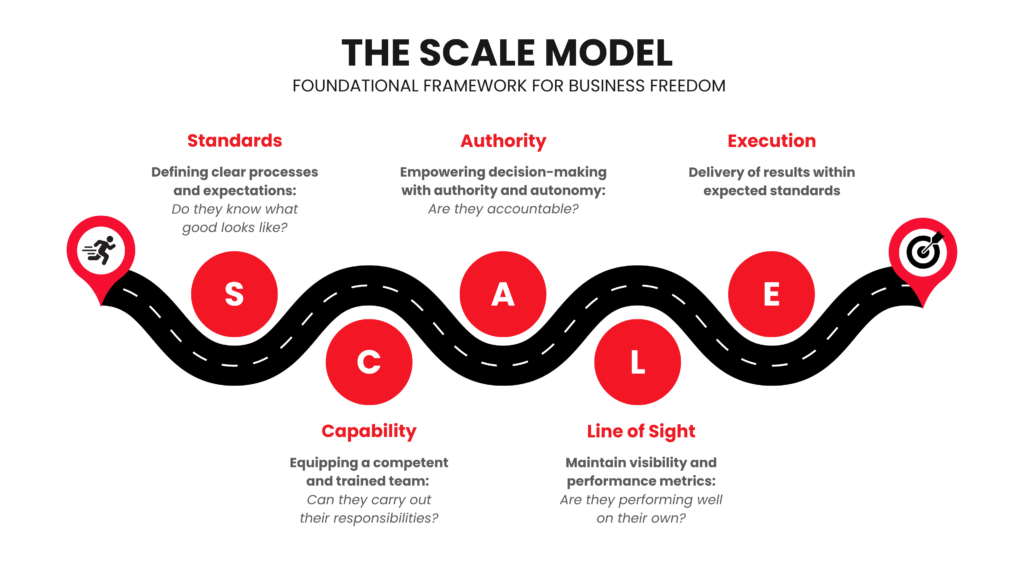
1-3-1 builds two of those. It grows your team’s capability to solve problems, and it creates the trust you need before you hand over authority.
Line of sight is what makes letting go feel safe. Instead of being pulled into every decision as it happens, you review the decisions on a schedule.
Once a month, sit down with your person and go through the decisions they made under their limit. You’ll probably agree with most of them. The ones you’d have handled differently become a coaching conversation.
Add KPIs that show whether each key job is on track. Now you know what’s going on in your business without being included in every detail of it.
Handing back the one-off problems gives you your week back
Here’s an action step you can take. The next time a one-off question comes across your desk, ask for a 1-3-1 instead of jumping in to solve the problem.
When your team brings you recommendations instead of questions, the interruptions get shorter. As your trust in them grows, a lot of those interruptions stop coming at all.
What you get back is time. You have room to think about the business, and to make the bigger decisions that only you can make.
Handing over decisions is something I help owners work through every week. If you’d like a hand doing it in your business, book a call and we’ll talk about coaching.
Our proven business coaching program has delivered results to over 400 clients
Business coaching can help you:
- Improve operations, implement systems and remove bottlenecks so that you get your time back
- Hire and train the right team and eliminate people problems
- Grow your business with bigger and better clients
- Overcome cash flow issues and improve your financial management
- Make better decisions and become more profitable
When your business runs well, you get your life back.
Services are confidential.
Click here for full details or click the red button to schedule a complimentary 15-minute call.

Coaching only works when there's a good fit between coach and client. If you'd like to explore coaching, book a confidential 15-minute call so we can get to know each other.
More on delegating decisions, building systems and keeping line of sight
Take Back Your Time
My video on why being the busiest person in the building is a leadership and structure problem, and how the 1-3-1 Rule stops you being the answer machine for your team.
Can You Take Two Weeks Off Without Checking Your Phone?
My presentation on the Owner Evolution and the full SCALE model, including the HVAC client who handed over authority for adjustments up to $250.
How to Delegate More Effectively
The three levels of delegation, from handing off a task to handing over authority and autonomy, and why the same person can sit at a different level for different work.
How to Delegate Decision Making (Not Just Tasks)
Why so many owners hand off the work but keep every decision, and how hats, haircuts and tattoos help you sort out which calls your team can make.
The Magic of Systems
Why systems run the business, people run the systems and you lead the people, and what to do with the 10% to 15% of your work that’s an exception.
Take Back Your Life: How to Develop Systems to Run your Business
Four steps to building systems in your business, from listing your recurring processes to asking how a system needs to change so an exception doesn’t happen again.
Using Checklists and SOPs to Develop Systems for Your Business
When to use a checklist and when to use an SOP, and why neither one works on its own for jobs that call for experience and judgment.
Unlock Efficiency and Consistency: The Power of Standard Operating Procedures (SOPs)
Five ways to create SOPs faster, including recording a short video and having the person you’re training write down the steps.
From Chaos to Control: 10 Tips for Developing Actionable Checklists for Business Operations
How to build checklists your team will use, starting with involving the people who do the work and keeping the list to one page.
How to be less involved in your business (without everything falling apart)
The three things that let you see what’s happening without being in the middle of it: numbers you can read at a glance, a regular check-in rhythm, and standards that live outside your head.
Are you tracking the numbers that matter?
What KPIs are, why financial reports only give you a rearview mirror, and the questions to ask about the scoreboard you have now.
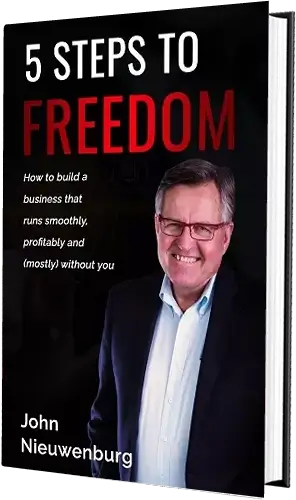
Build a Self-Managing Company
How to build a business that runs smoothly, profitably, and (mostly) without you.
Feeling stressed out and overwhelmed with a business that is taking all your time - and not giving you enough in return?
Are you finding it challenging to hire the right team (and get them to do the right things)?
I wrote this little guide for you!
Enter your details below to receive your free copy!