
When Everything in Your Business Runs Through You

John Nieuwenburg
John Nieuwenburg has been a professional business coach since 2004. Prior to becoming a coach, he held executive positions with Tip Top Tailors and BC Liquor Stores. In 2019, MacKay CEO Forums awarded him with Canada’s CEO Trusted Advisor Award in the Small Business category. Since becoming a coach, John has worked with over 400 clients, taking them through a systematic process that helps them feel organized, confident and in control of their businesses.
John Nieuwenburg on the Relentless Pursuit of Winning Podcast
You didn’t start your business to work 80-hour weeks. You started it because you wanted some form of freedom. Time freedom, money freedom, the freedom to make choices on your own terms.
Then the business grows. Your phone rings, pings, and dings all day. Every question comes back to you. Nothing happens unless you’re in the middle of it.
I recently sat down with Rick Meekins on the Relentless Pursuit of Winning podcast to talk about how to get out of the middle of your business and build one that gives you the life you want. In the conversation, we cover:
- Why owners will put up with 80-hour weeks for years, and what finally makes them ask for help
- Why the way you ran things with three people stops working at 10
- How to systematize your business when every job you do is different
- How to stop getting interrupted for every small decision without losing sight of what your team is doing
- The reason your team’s work keeps coming back different from what you had in mind
- How much of a strategic plan to have figured out before you bring your leadership team into the room
- Why only one kind of owner gets to decide how much time they spend in the business
- Why “it’s faster if I do it myself” costs you more every time you say it
- Why you shouldn’t be available to your team (and what to be instead)
You can watch the full interview below, or scroll down to read the conversation.
Who are you, what do you do, and why do you do it?
John: I’m a business coach. I started as a business coach in 2004, so 22 years now. I’ve worked with 450 clients, small business owners, typically in the trades or professions.
One way I could answer your question: shortly after I started as a coach, I had an epiphany. It was Steve Jobs who said, “You can only connect the dots going backwards.” My epiphany was some dots I connected. I realized, “Oh my gosh, I’ve always been a coach.”
Let me describe a few of them. The first is that I’m the eldest of eight children. You can imagine the role you’re cast into when you’re the eldest of eight.
I’m hardwired to be a teacher, and I knew that in high school. But in those days, that meant wearing a Harris Tweed coat with elbow patches. That bureaucratic, institutional style of teaching didn’t appeal to me very much.
In the early ’80s, I was blessed to learn something called the Socratic method of leadership. Socrates said the best way to help somebody is to help them figure it out for themselves.
At its core, that’s what coaching is. So I’ve been practising a coaching style of leadership since the early ’80s.
Is there a why behind it, or is this just what you were born to do?
John: This is what I was born to do. I was born to help other people.
Even at about 14, I was collecting my brothers’ and sisters’ library cards and riding my bicycle three miles to the library. I’d pick age-appropriate books for each of them. Three weeks later, when they were due, I’d do the same thing again.
No one ever asked me. I’m just wired that way.
What led you to become a coach?
John: I was the president of a very large retailer. About four billion in sales, 200 locations, 4,000 full-timers. And I decided I wanted to do my own thing.
For a while, I did a lot of retail consulting with some national brands. I’d usually step in and get something solved for them. That was a three-, six- or sometimes nine-month project.
What I discovered is that’s a very difficult business model. You work really hard on something for six months. Then the gig’s over, and you’re out on the street.
Coincidentally, I went to a conference, and there was a booth for business coaching. I thought, “I’ll go and chat with these guys.” Of course, that was the door opening.
It ultimately led to becoming a coach. And quite by accident, to discovering what my purpose in life is.
What is a coach, and what should someone expect when they bring one in?
John: The short version is, it depends who you ask.
If you go to some of the coaching academies, they’ll tell you a coach is a business version of a therapist or a counsellor. We ask questions. We help people uncover things, so they discover the answer for themselves.
That’s part of what coaching is, but I think it’s broader than that. I have some grey hair, so it’s about being a mentor and an advisor. Sometimes it’s being a teacher. And sometimes it’s, “Let me kick you in the backside, because you need to do something.”
So it’s a blend of all those things.
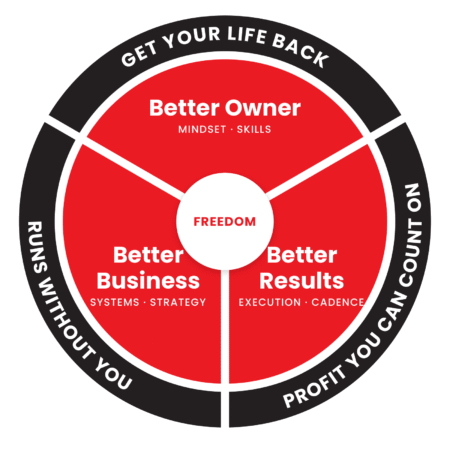
Coaching is about helping the business grow: systems, skills and strategy. It’s about helping the owner grow: mindset, communication, leadership, delegation skills. And the third is performance, or holding you accountable for the stuff you say you’re going to do.
That’s my two-second rant on what a coach is.
What’s a project you always go back to, where a struggling leader ended up with a very successful company?
 John: The one that sticks out for me is a client named Fred. Fred owned a factory with two shifts. It started at 6:00 in the morning and ended at 10 at night.
He was very much a hub-and-spoke manager. Let me take a minute to explain what that is.
Think of a bicycle wheel. It’s got a hub, and the wheel is supported by the spokes. If you take the hub out, what happens to that wheel? It falls apart.
He was that kind of leader. Nothing happened unless someone made a call. “Hey, got a minute?” Rings, pings, and dings.
He had an hour’s drive to the factory. So he’d leave around 10:00 and get home at 11:00. Then he had to be on the road at 4:30 or 5 to get back to the factory.
He did this for about 10 years. Relentless, stubborn, persistent. An “I’m going to do what it takes” kind of guy.
He would have kept paying that price for some time. But at one point, his wife said to him, “Your business is your mistress. If you don’t do something about it, I will.”
That’s when Fred had an epiphany. He was prepared to pay the price of 80-hour weeks. He was not prepared to pay that price.
That’s the important thing. We’re often prepared to do what it takes in the work. But when it has an emotional or personal consequence, that’s when we realize, “Oh gosh, I need to get some help. What I’m doing is not working, and it’s become important enough to me.”
I’m not going to my kids’ games. I’m not fully present for my family. My health is at risk.
Sometimes it’s some aspect of their personal life that ultimately drives people to say, “You know what? I need some help, because I can’t figure this out by myself.”
What was the resolution for Fred?
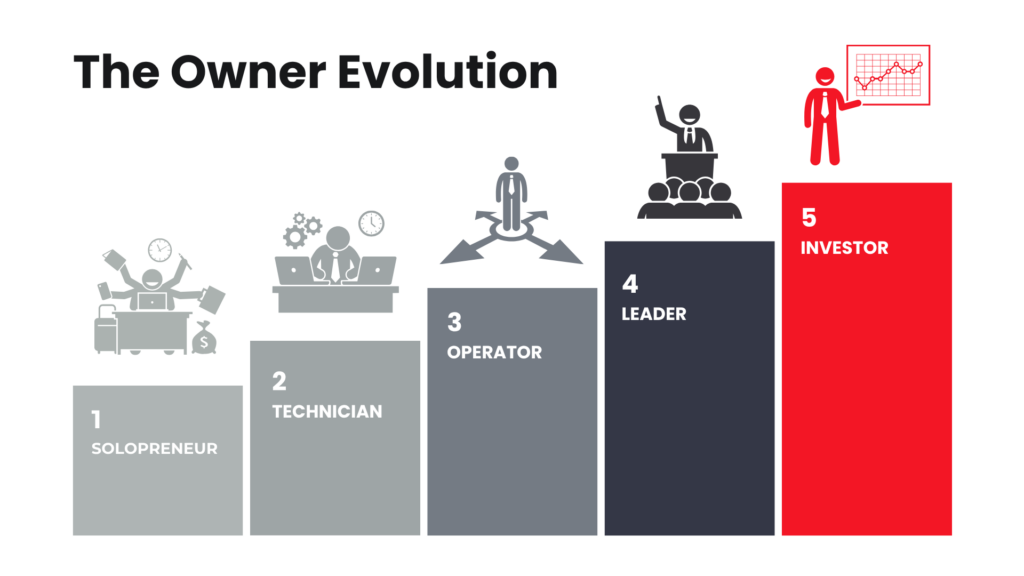
John: We worked at it for some time. But he got to a place where he recognized that what he needed to become is what I call the leader owner.
He was an operator owner. He was the hub.
The leader owner has a different mindset. They recognize that everything the business has to do has to be done by someone else. It cannot be me. My job is to lead the people who do the doing.
The hub-and-spoke guy gets a big juice out of it, right? You’re important. You’re getting these endorphins from the rings, pings, and dings.
When you become a leader owner, the environment is different. It’s quiet.
Instead of being the product of the environment, the tail wagging the dog, you get to work on things that are important but not urgent. Building the business. Introducing something that’ll save money or produce more money.
That’s a hard shift for an owner to make. They’re doing more valuable work, even if it doesn’t feel as pressing or urgent. Even if it doesn’t have all those endorphins attached to it.
It’s a skills question and a planning question. But more than anything, before it happens, there’s a shift in mindset. It’s how you identify what you think your job is.
You’re not the doer anymore. You’re the leader. And that’s a different set of skills.
I was working with a guy in a different practice. He was a PhD. What he came to understand was, “It took me a long time to get that PhD, but I did not get a single hour’s worth of business training. I’m really good at my practice.”
Of course, I’m not going to help you get better at what you do. That’s not where you need help. You need help understanding how to run a better business.
What happens when an owner who started with a trade or professional skill isn’t doing that work anymore?
 Rick: It’s interesting, talking about a person with a specific professional skill. They start the business with their skill or their trade, and then suddenly they’re not in that role anymore. There’s a re-identification.
John: Yeah. They usually start as what I call the technician owner. They’re still very much on the tools.
Maybe there’s another truck, and they’ve got two guys and a helper. But they’re still on the tools. They’re doing payroll on Friday at 8:00, because it has to get out the door.
Then they go from two trucks to 10 trucks. Oh my gosh, now they’re at the hub of everything. The thing they haven’t learned is what breaks when you go from three people to 10 people.
The story I like to tell about that is this. How many handshakes does it take for three people to shake each other’s hands?
The answer is three. A and B, B and C, A and C. Everyone does two.
There’s a formula for this: x squared minus x, divided by two. Three times three is nine, minus three is six, divided by two is three.
Now let’s make it 10 people. Ten times 10 is 100, minus 10 is 90, divided by two is 45.
What’s happened? The group grew by a factor of three. Complexity grew by a factor of 15. And you’re still trying to run the place as if it was just three people.
What worked at three people doesn’t work anymore at 10. First of all, you’ve got to see that. You’ve got to recognize it. Then you’ve got to know what to do about it.
With three people, we rely on personal trust. I can trust you. I know what you’re going to do. I saw what you did yesterday.
When it gets to 10 people, we have to start thinking about structural trust. What’s structural trust? Relying on systems, processes and protocols.
Let me give you a simple example. How does the air traffic controller know the pilot has done everything necessary to make sure the plane is ready to take off? They’ve never met. They can’t trust each other.
They’ve replaced personal trust with structural trust. Each of them has three, five, 10 years of training. They’ve passed some kind of board exam. Each of them knows there are protocols, checklists and SOPs.
If each follows their own protocol, each can trust that the system will produce the right outcome.
Or I’ll put it in a more personal way. Would you get on an airplane if you knew the pilot didn’t do the preflight checklist? Of course not. No one would.
So that’s the shift. I have to create a structure or a system that everyone can follow, which ensures we get the right outcome time and again.
How do you guide owners through the mental shift of letting go, so they can put the phone down at 5:00?
John: There are a bunch of parts to that question, but I’ll start with this idea. A well-run business is the product of a three-legged stool.
The first leg has three parts. Systems run the business. People run the systems. You lead your people. Your job is leadership.
Let me give you a simple example, just to tease you a little bit. How do they get the french fries to taste the same in your town or mine?
The fries are made by a 16-year-old. And that 16-year-old’s parents can’t get them to clean their bedroom. How do they do that?
They’ve got great systems. Great recipes. Just follow this process.
The second leg of the stool is that about 85% of what happens in a business ought to be routine. Here’s the system. Here’s the recipe. Here’s the SOP. This is how we do it.
Fifteen percent of the time, stuff happens. Something breaks.
One Saturday night at 10:00, we run out of potatoes. We don’t know what to do, so we phone the owner. “Hey, what do we do?” And we do something to make it work.
The third leg of the stool is that when something like that happens, we don’t look for a people solution. We look for a system solution.
What would the system have to be to prevent running out in the first place? Or if it did happen, how would we know how to solve it without making that phone call?
So it’s building systems for every aspect of the business. How do we take a call from a customer? What’s the system for that? What happens after that? We put it into some kind of order process. What does all of that look like?
One of the pushbacks I get on this a lot is, “I’m a general contractor. I build these $5 million homes. I’m not making french fries.”
You’re right. You’re not. It’s not a repeatable product. The product is unique, but what has to be systematized is your process.
The process of producing that home is the system. The actual output is whatever is on the blueprint.
So in complex environments, it’s the process. You’re relying more on checklists and less on SOPs. A checklist ought to initiate a familiar routine that causes you to do the right things.
There’s a story of a surgeon who started with 30 scalpels. He buttoned up the patient, and then they went to count. There were 29. Oops.
Maybe we should have counted before we decided to close it up.
How do you let go of a process when you know all the things that can go wrong?
 Rick: We create these processes as leaders, and it’s really hard sometimes to just create the process and step away, because you know the sorts of things that can go wrong. And when we create processes, there are things we know intuitively that may not translate into the process. So we have this fear of letting go, and we’ve got to learn intentionally how not to do that.
John: Exactly. That’s one of the mindset shifts that has to happen between being an operator owner and a leader owner. It will break sometimes.
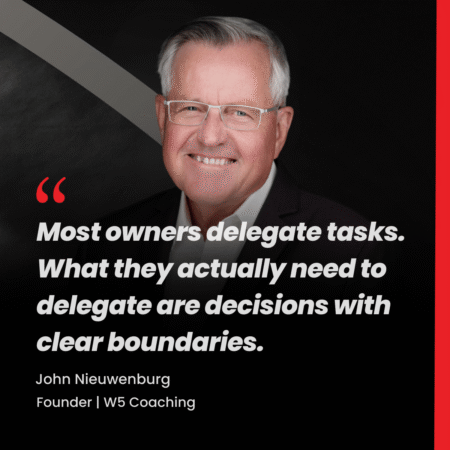
But what has to be understood is that many owners think about delegation as delegating tasks. “I’m just getting a pair of hands.” That’s not what delegation is at all.
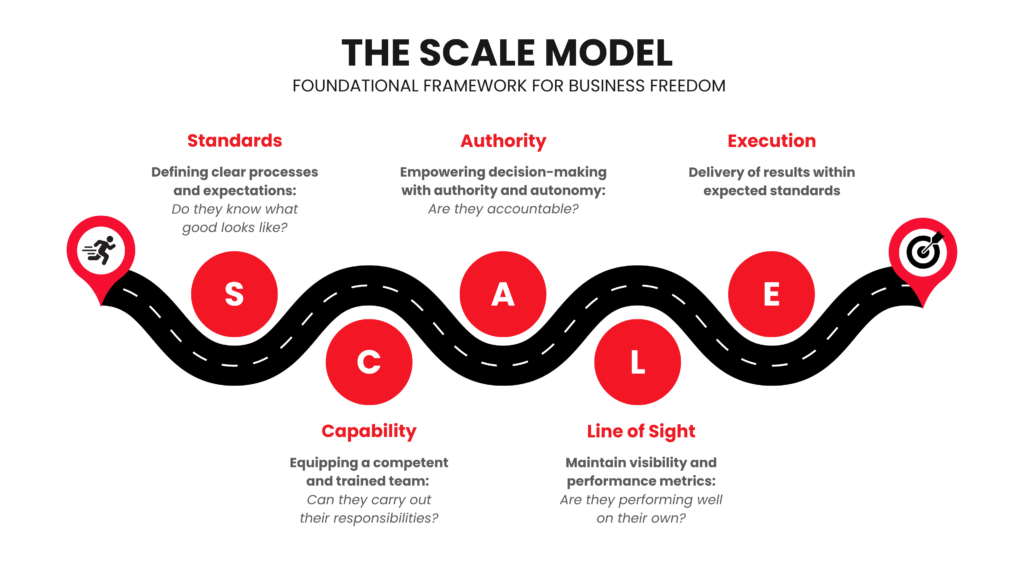
Delegation is delegating autonomy and authority. Autonomy and authority. You’re delegating to a set of brains inside a set of rules.
I’ll give you an example. I have an HVAC client, a large business, $80 million. They produce 250 to 300 service ticket invoices a month. Of those, sometimes 10, 15, 20 need some kind of adjustment.
So my client, the owner, was getting interrupted 10, 15, 20 times a month. “Hey, can we make this adjustment? Here’s the reason.”
Very much a hub-and-spoke response, right? Something’s wrong, so I’ve got to talk to the boss. Knock knock. Got a minute? The boss is disrupted.
He’d been delegating a task. Instead, he shifted the approach. He said to her, “You can do up to a $250 adjustment without asking me. Just do it. I’ll rely on your judgment.”
Her response, by the way, was, “I don’t want to give away 250 bucks.” That’s when he learned, “Oh, I’ve got the right person.”
The thing you’re afraid of is letting go. The thing you need is line of sight.
What does that mean in this circumstance? Once a month, let’s sit down with the 20 you made an adjustment on. Walk me through the reasons. I’m probably going to agree with 18 of them.
There might be two I would have handled differently. I won’t criticize you, but together we’ll agree on what’s more appropriate next time.
You’re not letting go in the sense that you have no insight, or that you’re blind to the thing. You’re changing the way you get insight. The way you get control.
That becomes a system too. There’s a routine, and once a month we check in.
What do you think of backing a team member’s decision even when you don’t agree with it?
Rick: I have a team member I’ve delegated certain things to, and every once in a while I don’t agree with a decision she’s made. But I’ve made a commitment to support her regardless. A lot of what we do, especially engaging with an audience, is kind of a guess. It’s instinct. How do you feel about that approach?
John: There are a couple of aspects to it. One of the best ways to delegate is something called the 10/80/10 rule.
The first 10% of the task is you, the leader, explaining what good looks like. What you want the outcome to look like.
The 80% is the work done by that person.
And the last 10% is you putting your special sauce on it. Commenting on it, tweaking it, finessing it.
That’s a way you can still be in control. You start the project and make sure it gets started the right way. The bulk of the work gets done by someone else.
And it doesn’t go out the door until it’s satisfactory to you. If it needs some tweaking or finessing, you’re in a position to coach that person.
What you’re really doing with that method is teaching people how to think, not what to do. How to think.
The feedback you give them helps them get a better outcome the next time, because they’ve understood your methodology. The way you think about that situation.
Rick: I always find it important for them to be able to express themselves and bring their creativity to things. Like you said, every once in a while we go through and say, “Okay, here are five things. What made you make this decision?” Versus, “Oh, this is wrong.” It empowers them.
John: It does. I’ve got a great example for you, though.
I have a client who owns a home staging business, and that business employs a full-time social media person. My client was complaining to me that the social media person had gone crazy. Using fonts and music that were totally off brand.
That’s when I said, “Well, that’s because you haven’t set the guardrails. Show me your brand guide. What’s the range of fonts you’ve approved? What would be out of bounds?”
Now you’ve got protection and agreed-upon expectations. This kind of music isn’t appropriate. The kind of music we’re looking for is luxurious and elevated. Those were the two words she used.
So how would that look in music? What does elevated mean when it comes to music? What does elevated mean when it comes to fonts? Okay, let’s write a rule book.
Ultimately, I said to her, “Why are the Ten Commandments written in stone? Because we don’t debate them. ‘Thou shalt not kill’ is a commandment. Where are your brand guide commandments? You don’t have any. That’s why you’re not getting the results you want. You don’t have an agreed-upon idea of what good means.”
The social media person was operating with a different premise of what good looked like than my client was. Because they didn’t have that agreement, there was conflict and tension. She wasn’t satisfied with the results she was getting.
So the fault was really in the leadership. Or in the system that didn’t exist.
How do you recommend a leader bring a new idea to life with their team?
John: The example I like to use is a strategic plan.
Would you ever show up to your leadership team with a blank sheet of paper and spend the whole day doing a strategic plan? That’s a bad use of a day. Not much is going to happen, and not much of it will be helpful.
You’ve got to arrive with a strategic plan that, in your mind’s eye, is about 90% good. But how it gets presented is, “I’ve been working on this. I think I’m in the ballpark of probably 60% good. Why don’t we spend the day getting some input from everybody around this table? When we leave today, our goal is to make sure we’re 100% on the same page.”
So you start from a known point. You’ve got pretty clear ideas, but you’re also open to the idea that there are other ideas on the table. That’s number one.
Number two, the real purpose is to get everybody on the same page.
A strategic plan, as an example, is 5% vision and 95% alignment. Of course you’re looking for some crazy map of the future. But if everybody’s going off in their own direction, you don’t really have a strategic plan.
So the more important goal is alignment.
Many of us go into business for freedom and end up losing the balance with family and everything else. What do you say to owners caught in that web?
John: Let’s start from a bigger picture. Let me ask you something. What’s the purpose of a small business?
The answer I want to give you is a bit counterintuitive. It wouldn’t be the answer you’d give your customers, your vendors or your leadership team. But the real purpose of a small business is to give you, its owner, the life you want.
What happens is what you’re describing. We get so wrapped around the axle of a business that we lose sight of what we’re trying to do. Nobody was born to business. We were born to live.
So first, let’s be clear about what you want out of life. Then let’s build the business that gives you that.
What would have to be true about your business so that you’re living your life? If we keep that as our north star, we’ll be doing the things it takes.
You didn’t start this business to get wrapped around the axle. You started it because you wanted some form of freedom. Time freedom, money freedom, freedom to make choices on your own terms. Let’s work towards that goal.
In most cases, that doesn’t happen in two months. It can be two years, sometimes more. But along the way, you’re also building your wealth.
As business owners, we often get very focused on profit. That’s what we’re here to do, build profit.
Let me give you an example. Let’s say Acme Corp does about a million in profit each year. Someone will pay $5 million for that business. Five times EBITDA. That’s pretty good.
So we work really hard for a year and add 10% to profit. That’s $100,000. Pretty good.
What if we spent the same effort adding 10% to the asset value of the business? That’s $500,000.
You can do both of those things at the same time. What it takes to make a business attractive to a buyer is exactly the same as what it takes to make the business give you time and money freedom.
I’ll put it a different way, since I’m a McDonald’s guy. (Or not really, but I use that example.) How much is the owner of a McDonald’s restaurant required to be in the restaurant?
As much or as little as they like, because they’re an investor owner.
So there’s the operator owner, there’s the leader owner, and now there’s the investor owner. The investor owner’s job is how to allocate capital, and how to think about strategy and growth. The day-to-day operations are now someone else’s. That owner often has true freedom.
What’s interesting is that craftspeople often go back to the craft they started the business doing, because that’s the thing they enjoy. But now they get to do it on their terms.
It isn’t a requirement. It’s something that brings them joy.
What does the journey to that kind of freedom look like?
John: The first place to start is how you spend your time.
The first thing I ask a business owner (and I’m going to use a term here) is, “Tell me what’s on your oh-sh*t list.”
“My what?”
“Your oh-sh*t list. The things that cause you to say to yourself, ‘Sh*t, I have to do payroll. I have to do receivables.'”
That’s a clue. If your intuition is telling you that, it means you should no longer be the person doing that work. There’s more important, more valuable work to be doing.
So if I need my receivables done, how do I organize that so I can delegate it to somebody who’ll do it at the level I require?
Once you get those administrative things going, what are the next things on your oh-sh*t list? Now it scales up. It might be something like, “I don’t like having to take phone calls from clients.”
Okay. It sounds to me like you’ll need a sales department. How do we get a sales department? Let’s build that thing.
Ultimately, if you keep reducing or eliminating the things on your oh-sh*t list, you eventually get to the place where you’re the investor owner.
So it really starts with this internal question. Tell me the things you don’t want to be doing. That’s often a clue.
Take the receivables work. Depending on where you are in the country, you can hire someone to do that for, let’s say, 20 bucks an hour.
So why are you, the owner, doing work that someone will do better than you for 20 bucks an hour? What do you do instead? Let’s think of some work that’s worth 100 bucks an hour, or 500 bucks an hour. Work that produces more value for the business.
Right now, you’re jumping over dollars to get to nickels. Dumb. Let’s stop it. Get that stuff off your plate, so we can focus on the dollars instead of the nickels.
It’s a metaphor, of course. Every circumstance is different, and every business is different. But that’s the framework. That’s the mental model.
Keep examining what produces value in the business. The work only you can do, and the work someone else should be doing. As you scale, the questions you ask yourself become different.
How do you stay focused and committed to each step when building systems feels like a mountain on top of client delivery?
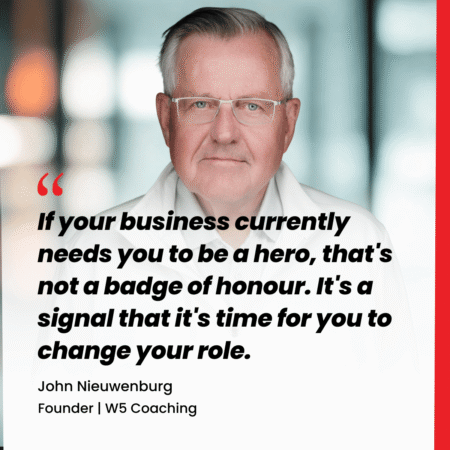 John: That’s where having someone to help you with structure and discipline is useful. I.e., a coach.
We often get stuck the way you’re describing. The role of the coach is to help you find that path, and keep defining it as you go forward.
You just said something that reminded me of a thing I call delegation debt. What’s delegation debt?
“It’s easier if I do it myself. It’s faster if I do it myself. It’d take me much longer to explain this to somebody.”
Okay. In the moment, you’re right. It’ll take you 10 minutes to do it and 30 minutes to explain it to somebody.
But what about the second time? The 20th time? The 50th time? You’ve paid that debt 50 times now, and you’re still doing it yourself.
So what’s an investment? I’m going to put in a little effort up front to get a bigger return later. Stop paying debt. Make an investment.
Yes, it takes more time in the short term. But ultimately, that’s what frees you up to do more and more important work.
That’s the hurdle a business owner has to overcome. The investment in the coaching, the training, the system building, whatever it takes, produces a benefit. But it won’t be immediate. It won’t be today. It may be tomorrow. It’ll likely be in a month.
Stop paying delegation debt. “It’s faster to do it myself.” How long do you want to keep saying that to yourself? Next year? The next 10 years? “Do it yourself. It’s faster.” Yeah, it is.
Rick: That’s one of those loops. I remember years ago, it took me forever. My wife would say, “You need to hire somebody.” And I’d say, “No, I don’t want to pay the money.”
John: I’ll put it this way. Not to you, Rick, but many times to business owners, I’ll ask this question. “Do you have a virtual assistant? You don’t? Well, then you know what? You’re the virtual assistant, and you’re lousy at it.”
So what’s leverage? What’s the definition? Doing more with less.
A VA isn’t an expense. It’s leverage. It allows you to get a return on that investment. If you think of it as an expense, you’re doing it wrong.
If I spend $2,000 a month on a VA, and that allows me to create $10,000 or $100,000 or a million dollars of value, that’s a pretty good return. Thank you very much.
So don’t do the work a VA will do better than you just because you’re stuck thinking of it as an expense.
Rick: It was definitely a fantastic investment. I think about my VA now. She’s fantastic, and I can’t do what she does. She’s very detail-oriented. I’m very big-picture.
John: Perfect example. They often complement the areas that need attention, where we’re not the person best suited to do it.
How does someone go about finding a great coach?
John: To me, it’s that you arrive at a meeting with that coach, and the coach helps you articulate and define your current set of problems.
Many times, it’ll be the first time the owner has said it out loud to someone else. “Here are the challenges I’m facing.” Then the coach helps you think about what you’d need to do to solve them.
If you can find someone who can help you in that way, that’s the resource you’re looking for.
I was working with a client named Brad. After about four months, I asked him, “Hey, what do you like most about having a coach?” He said, “It’s great to have a friend.”
At the time, that answer embarrassed me. I thought, “Oh my god, this guy’s paying me to be his friend.” But as I reflected on it, what I came to understand is that being a business owner is lonely.
Who can you talk to? Your banker, your lawyer, your accountant, your second in command?
In my case, if I want to talk to my wife about something business-related, it takes me 30 minutes to explain it, by which time she’s bored. Or she gives me advice in five minutes, and it’s not very helpful. So even at home, there’s no one who truly gets it.
That’s the purpose of a coach. Someone who understands the world you’re in and lets you think out loud. So much of the stuff we need to do is just rolling around in our heads.
I’ll tell you, I often have an hour’s meeting with my own coach, and I’m finished in 10 minutes. In those 10 minutes, I start articulating the problem. It’s the first time I’ve said it out loud.
As soon as I’m saying it, I’m almost embarrassed. “Okay, I know what I need to do. Thanks a lot. See you next time.”
So back to your question. You want the kind of person who can help you think out loud. Articulate what’s on your mind, define the challenges, and agree on what needs to be done next.
Rick: A thinking partner.
John: Yeah, that’s a good way to think of it.
Now, if you’ve never had a coach, you’re thinking, “Man, I’m paying this guy to think with me? I can’t believe that’s worth anything.” Well, that’s because you haven’t experienced it.
There are lots of ways to find good coaches. But if you’re struggling with something, vexed, or don’t know what to do next, that’s a clue. That’s your intuition telling you, “I need some help with this. Where can I get some help?”
Is there a point at which someone is or isn’t ready to work with a coach?
John: There are a number of things, but here’s the thing. I can’t do your push-ups. You need to do the work.
If you expect talking to a coach to be some kind of magic wand, that’s not going to work out. You have to recognize that a coach is not a consultant. I’m not there to do the work. I’m here to help you figure out what needs to be done.
So coaching requires a commitment to the session, and coming prepared and ready to deal with something.
It also relies on having a session with yourself. An hour with the coach, and at least an hour a week to do whatever you said you were going to do.
Otherwise, there’s lots of lovely conversation, and all of that might be fun. But you’re wasting our time and your money.
Rick: That’s very wise.
What’s the most important thing you’d leave our audience with?
 John: I have a million of them. What’s the most important? The results you get in life are a perfect reflection of how you spend your time.
So here’s a clue. If you’re not getting the results, it’s because of how you’re using your time.
One of the questions I like to ask is, “Do you have a default diary?”
“What’s that?”
Then you don’t have one, and you’re not getting the results you want in life.
A default diary answers four questions. Number one, what are the most important results I need to get this week or this month? Number two, what work do I do? Number three, how much of that work? And then, how do I match my time to the answers to those three questions?
Do that once a week.
We’re so busy that we never take time to organize. What I’ve come to understand is that organizing work is different from doing work. And as entrepreneurs, we’re usually not very good at organizing.
That’s the most important thing an executive assistant will do. They’ll organize your inbox, your time, and your priorities, because now you have to articulate them to somebody.
Your EA takes notes and puts it in your calendar. The next day, you’re meeting with your EA, and you say, “Well, I didn’t do what I said I was going to do.” That’s not going to last very long, is it?
You get to keep the promises you make, because you’ve expressed them out loud. That’s one of the great values of an executive assistant. They help you stay organized.
The most important thing we have as entrepreneurs is how, and to what, we pay attention. It’s the most valuable thing you’ve got, and usually it’s the least managed resource.
We think we have to be available. The truth is, you shouldn’t be available. You should be accessible.
The difference is that accessible means on your terms, when it’s right for you. Instead of the phone ringing, pinging, and dinging, and someone knocking at the door. “Got a minute?” Now the tail is wagging the dog, man.
So back to your question. Your results are a perfect reflection of how you spend your time.
How do you maintain the relentless pursuit of winning?
 John: You’ve got to know why you do it.
A man named Viktor Frankl wrote a terrific book called Man’s Search for Meaning. The backstory is that he was a professor of psychology at the University of Vienna. He studied human behaviour. And as it happened, he got thrown into Auschwitz.
In Auschwitz, he came to discover that on any given day, he could tell who was going to die. What was peculiar is that healthy people died, and sick people lived. What was going on? What was causing that?
What he came to understand is that the people who had a why would figure out a way to live, even in the worst of circumstances. If you didn’t have a why, it was like, “What’s the point? I’ll just give up.”
The second thing that’s interesting is that it doesn’t matter what the why is. It just matters that it matters to you.
For some people, it’s, “I want to smell green grass. I want to get back to my village. I want to see my spouse.” Whatever matters to you. That’s the thing that’ll pull you through, or compel you to do the hard things that are necessary.
You’ve got to know why it matters. What it all adds up to.
It can be hard to define that. And that’s often why we live unhappy lives, because we don’t know exactly what purpose we have in life.
Once you do, it becomes clear. Things that don’t get me to my purpose, I just won’t do them. Doesn’t matter. I get to say no.
If you don’t have that, everything seems important.
Rick: You’ve got to know your why. I love that.
How can someone get in touch with you?
John: It’s pretty easy. I told you about the Socratic method, based on questions. What are the five core questions? Who, what, when, where, why.
So it’s W5 Coaching on the internet. And john@w5coaching.com gets you in my inbox.
Rick: Fantastic. We’ll get that in the show notes. Thank you so much, John. This has been an enjoyable conversation.
John: My pleasure. Thanks for having me.
Our proven business coaching program has delivered results to over 400 clients
Business coaching can help you:
- Improve operations, implement systems and remove bottlenecks so that you get your time back
- Hire and train the right team and eliminate people problems
- Grow your business with bigger and better clients
- Overcome cash flow issues and improve your financial management
- Make better decisions and become more profitable
When your business runs well, you get your life back.
Services are confidential.
Click here for full details or click the red button to schedule a complimentary 15-minute call.

Coaching only works when there's a good fit between coach and client. If you'd like to explore coaching, book a confidential 15-minute call so we can get to know each other.
More on getting out of the middle of your business, delegating authority, and building a business that gives you the life you want
Stuck in the Middle of Everything? It’s Time to Become a Leader Owner.
The five stages of the owner evolution, plus the full story of the factory owner who was in his car by 4:30 every morning for ten years.
Do You Have a Job? Or do You Own a Business?
A closer look at each level, from solopreneur owner to investor owner, and how to tell which one you’re in now.
The Hidden Math of Complexity
The handshake formula worked through in full, and the four fixes I recommend once your team grows, starting with a team meeting rhythm.
Why Can’t I Trust My People to Do the Job Right? (It’s Not What You Think)
The shift from relational trust to structural trust, and the seven conditions that have to be in place before you can rely on it.
The Magic of Systems
Why systems run the business and people run the systems, and what to do with the 15% of the time something goes wrong.
Can You Take Two Weeks Off Without Checking Your Phone?
My presentation on standards, authority and line of sight, including the HVAC client who handed over authority for adjustments up to $250.
How to Use the 10-80-10 Principle to Delegate Like a Boss
How to hand off work you’re good at while keeping the first and last 10% for yourself.
How to Reclaim Your Time with the “Oh Sh*t” List
How to use the list to find the low-value work you should be handing off first.
Lessons from a CEO: Five Insights for Small Business Owners
Five lessons from my years as CEO of the BCLDB, including why a strategic plan is 5% vision and 95% alignment.
What is it Like to Work with a Business Coach?
More on the client who told me “It’s great to have a friend,” and why the top seat in a business is such a lonely one.
Staying Accessible Without Losing Control
How to stay reachable for your team and customers without spending your day reacting to rings, pings, and dings.
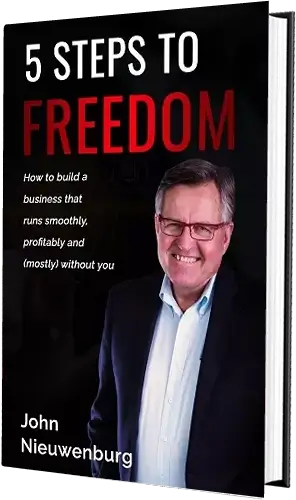
Build a Self-Managing Company
How to build a business that runs smoothly, profitably, and (mostly) without you.
Feeling stressed out and overwhelmed with a business that is taking all your time - and not giving you enough in return?
Are you finding it challenging to hire the right team (and get them to do the right things)?
I wrote this little guide for you!
Enter your details below to receive your free copy!